Thursday, April 30, 2026

Two different Peter VanDerHoofs who died in 1913?

In the Rockaway Valley United Methodist Church Cemetery is the gravestone for:

Note that the stone is etched with years and not months and days. The memorial page at Find A Grave has Peter's date of death as May 26, 1913.

Memorial page at Find A Grave
Peter Vanderhoof 1844-1913
Rockaway Valley United Methodist Church Cemetery
Boonton, Morris County, New Jersey

In the New Jersey State Archives, I found a death certificate for Peter Vanderhoof. The date of death on this record was July 13, not May 26. This Peter died at the Odd Fellows Home in Ewing, Mercer County and was buried in Rockaway Valley.

Death certificate of Peter Vanderhoof
died July 13, 1913 in Ewing, Mercer County, New Jersey

Is this the death certificate for the Peter on the gravestone? The age, 67 years, is almost identical. Widower is consistent. Across his many records, Peter, husband of Betsey, is not listed as the occupation "teamster." No family members are listed on this death certificate. The informant seems to have been an employee of Odd Fellows Home.

In the newspapers for the Ewing area and for Morris County I did not find a notice of death or obituary.

What was the source of the precise date of death on the Find A Grave memorial? I don't know. I can't find it. I'm not saying that it doesn't exist, only that I have yet to come across it. The year could be wrong on the stone. This happened with Hila Vanderhoof (1803-1888) in this same cemetery. She died in 1888, but the year on the stone is 1886.

There is a transcription of grave stone inscriptions for this cemetery. Only the years are provided for Peter.

Peter's entry in the transcription of gravestones
Rockaway Valley Methodist Church Cemetery by Illig.
Vanderhoof Peter 1844 - 1913

I found Peter and Betsey's stone in the cemetery. There were no flat stones or other markers to clarify the date of death. Sometimes members of Odd Fellows carved "F L T" inside links on the gravestone. Friendship, Love, Truth. I did not see this on Peter's stone.

October 11, 2025
Rockaway Valley United Methodist Church Cemetery


Example of links of Odd Fellows carved on a stone- upper right.
The symbol above the links is a square and compass for the Free and Accepted Masons.
GAR in the upper left symbolizes membership in Grand Army of the Republic- Edwin's military service during the Civil War.
Edwin Marsh (1843-1917) and wife Elizabeth Brook (1843-1920)
Evergreen Cemetery in Hillside, Union County, New Jersey
Picture taken August 26, 2011 by J Lutter

Conclusions

Are these two separate men named Peter Vanderhoof who lived in the same area at the same time? Possibly. I have sixty men named Peter Vanderhoof in my tree.

The death certificate is proof of the precise date of death. The information on Find A Grave is not. But the death certificate does not link the decedent to his larger family, so we cannot be sure who he is.


Friday, April 24, 2026

The Tragedy of Willard's Cemetery

Imagine enduring a difficult life within the confines of a mental institution, only to be laid to rest in an unmarked grave identified by nothing more than a number. No headstone with your name and dates. Even in death, you remain unreachable, as the records that could guide loved ones to your grave are withheld. This is the ongoing injustice faced by those buried in the defunct cemetery at Willard Asylum in Seneca County, New York.

Find A Grave memorial page for the person buried in grave 13.
New York will not allow anyone to see who lies in this grave.

The facility was known by several names over the years. Asylum and Insane are words that have fallen out of favor in current American English. Willard State Hospital is a defunct facility that housed tens of thousands of people deemed "insane." The remnants are located in Willard, a hamlet of Romulus, Seneca County, New York.

Modern map showing location of Willard Hospital and its cemetery

Willard was one of the many state hospitals created in the 1870s in response to a growing movement to treat the mentally ill better in sprawling campuses and formally trained staff. (See my article on Nurse Julia Flanagan.) A centralized state facility relieved the counties of financial burdens of insane paupers. Most patients were too poor to provide for themselves. And some of them were mentally ill by today's standards.

And- they were called inmates, not patients as we do today. They were literally locked up with no recourse. They had few recognized rights. Medications to treat schizophrenia were invented in the 1950s.

Part of the hospital grounds includes a cemetery where the patients were buried. Most plots were not marked, meaning no stones were erected. (This was a standard practice. See my article mentioning burials of Edith Duryea and her child in Laurel Hill in Secaucus, New Jersey.) Records were created and maintained over the decades and were sent to the New York State Archives. Today the cemetery is in disrepair.

Here's the problem: the records of this cemetery are prohibited from being viewed. Why? No logical reason, in my opinion. The boxes of records are described on the webpage of the Archives' finding aidA New York State law is cited as the authority for blocking access.

"Access Restrictions. Restricted in accordance with Mental Hygiene Law, Section 33.13, relating to confidentiality of clinic records."

I can't excerpt the wording in this law that prohibits access to cemetery records because NONE EXISTS. This law clearly pertains to confidentiality of very recent patient CLINICAL records because it discusses who may receive records: police, targets of the patient, and close family members. There is no mention of great great grandchildren's access. The spouses and children of patients in these sought-out historical records are also dead. They can't request access to records.

There is a bill in the New York State Legislature that would make public these burial records.¹ It's a shame that all that effort and time must be lodged to counteract a deliberate misapplication of a law. 

If the burial records were allowed to be viewed at the Archives, I doubt many people would look at them. Part of the reason is that they would essentially be inaccessible to people who do not live close to Albany and can visit during the few hours the building is open.

If the burial records were digitized and placed online, a few more people would view them, but not many. Where is the harm? I see only benefit. The "inmates" had no rights once locked away. Prohibiting access to their burial records completes their sequestration from society and their families. It's simple cruelty.

Inhabitants of institutions were included on the federal census every ten years. Although a person was removed from society, this process and their status at Willard was not a contemporaneous secret. Below is a page from the 1900 federal census for Romulus and Ovid listing patients at Willard State Hospital.

1900 United States Federal Census
Patients at Willard State Hospital
Ovid and Romulus Towns, Seneca County, New York

Clinical records of inmates can include detailed descriptions of their family relations and the circumstances that lead to placement in the state hospital. This provides missing insight into past generations and is invaluable to genealogical studies.

For further reading on advocacy of Willard Hospital, please see the blog The Inmates of Willard

At Find A Grave, 727 burials are listed. Some veterans and numbers have pictures of stones. Most are names without pictures.


Other States

Other states have placed records online relating to mental health records and burials of the these people.

Below are images from records available for Rhode Island and California available on Ancestry.

Burial ledger. Dexter Asylum in Providence, Rhode Island.
Collection at Ancestry
"Providence, Rhode Island, U.S., Dexter Asylum and Almshouse Records, 1828-1956"

Case Books, Personal Description List (Females), 1900-1920
Sonoma State Hospital, Eldridge, California
Collection at Ancestry
"California, U.S., State Hospital Records, 1856-1923"


Future Endeavors

It's time to release these stigmatized records in all states and allow researchers to uncover family mysteries and bring to light the historical treatment of people deemed mentally ill.


¹ New York Senate Bill S08903 and Assembly Bill A10242, 2025–2026 legislative session.


Tuesday, April 21, 2026

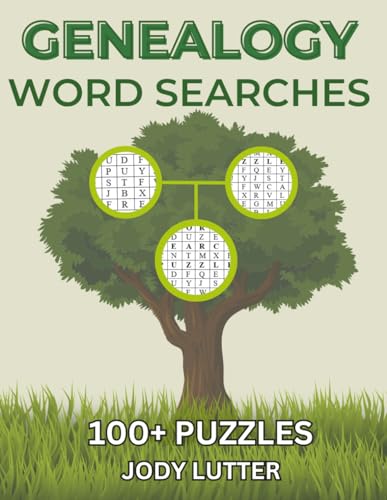
Genealogy Word Search Book

I published my first book.

It's a fun word search book with genealogical terms and themes.

I always thought my first genealogy book would be reference, but here we are in a completely different direction.

Genealogy Word Searches by Jody Lutter

Genealogy Word Searches

by Jody Lutter

Enjoy a fun and engaging way to explore genealogy with this collection of word searches. Perfect for family historians, researchers, and anyone who loves puzzles with a historical twist.

Wednesday, April 15, 2026

Multiple Marriages in the 1910 Census

The United States federal census provides a framework for tracing families every ten years (except the mostly destroyed 1890). Later census forms asked more detailed questions of all members of households.

Marital status became a question in 1880.

The 1910 census asked two questions about marital status:
Question 8. Whether single, married, widowed, or divorced.
Question 9. Number of years of present marriage.
Questions on the 1910 federal census.
Questions 8 and 9 pertained to marital status.

Enumerators were to mark answers in accordance with rules that are not reflected on the census form. The rule for question 8: ". . . if this is the first marriage, write 'M1,' but if this is the second or subsequent marriage, write 'M2' (meaning married more than once)."
Instructions to the enumerator about how to record the answer
to Question 8 about marital status

Answers on the census can be wildly inaccurate. But the 1910 census can mislead the researcher with the answers about marriage. M1 means first marriage, but M2 means more than one marriage, not necessarily the second marriage.

We will look at two people to illustrate this question in the 1910 census, Albert Baldwin Duryea (1853-1924) and Minnie Tuthill (1870-1941).

Albert Baldwin Duryea

Albert was the son of George Winfield Duryea (1823-1892) and Barbara Ann Savidge (1825-18xx). He was born around 1853, probably in Montgomery, Somerset County, New Jersey.

On March 18, 1882 Albert married Margaret Lear Heavener (1851-1903) in Upper Black Eddy, Bucks County, Pennsylvania. This union produced two children, Paul Gamble Duryea (1883-1966) and Edwin Jayne Duryea (1886-1942).

On May 6, 1905 Albert married Virginia Stryker (1854-1907) in Trenton, Mercer County, New Jersey. Virginia was the widow of William S Barr. She died two and a half years later from cancer of the bowels.
Marriage certificate
Albert B Duryea and Virginia S Stryker
married May 6, 1905
in Trenton, Mercer County, New Jersey

On May 15, 1908 Albert married Elizabeth Tinsman Morris (1850-1925) in Trenton.
Marriage certificate
Albert Baldwin Duryea and Elizabeth Morris Comly
married May 15, 1908
in Trenton, Mercer County, New Jersey

This brings us to the 1910 census. Albert Duryea and his wife Elizabeth were enumerated in Trenton with a boarder, William Hillpot.
1910 federal census in Trenton, New Jersey
Household of Albert Duryea


For Question 8, "M2" is written for the marital status of Albert and Elizabeth. Elizabeth had at least one prior marriage (looks like "Comly") on her marriage certificate to Albert. We found three marriages for Albert. This is an illustration of M2 properly indicating more than one marriage and not second marriage.
Close up of 1910 federal census
Albert was on marriage number 3. "M2" was the correct response.

Minnie Tuthill


Tuthill or Tuttle and variations is a popular name from Suffolk County, New York. Minnie was born around 1870 in Riverhead to Albert Daniel Tuthill (1846-1920) and Hannah Erskine (1847-1927).

Minnie's marital history is vague at times, but we will see what we can see.

On January 10, 1887 Minnie C Tuthill married John Edwin Duryea in Riverhead- according to the New York State Marriage Index. As of this writing, New York is still refusing to release genealogical copies of records.

In the 1900 census, Minnie Gusswiller was enumerated in Jersey City, Hudson County, New Jersey with her husband, Frank Gusswiller. They were married for nine years. She had six children, four still living, listed with birth years from 1888 through 1899, all using the surname Gusswiller.

John E Duryea died February 22, 1901 in Trenton, Mercer County, New Jersey. 
Death certificate of John E Duryea
died February 22, 1901
in Long Branch, Monmouth County, New Jersey.

If Minnie Tuthill married Frank Gusswiller around 1891, she would have need to have divorced her first husband, John Duryea. I use "if" because I have not found a possible entry in the marriage indexes for Minnie and Frank in New Jersey, New York, and New York City.

This brings us to the 1910 census. Minnie Woodin and her husband, William Woodin, were enumerated in Poughkeepsie, Dutchess County, New York. His marital status was "M1," married five years. Her marital status was "M2," married five years. She had ten children, six still living. With them were five children. Four children were named Gusswiller and were ages 9 through 19. William Woodin, final child, was three years old.
1910 federal census in Poughkeepsie, New York
Household of William Woodin

Close up of 1910 federal census
Minnie was on marriage number 2 or 3. "M2" was the correct response.

The answer "M2" means that she was married at least twice and is not indicative of whether she and Frank Gusswiller actually married.

Minnie continued marrying after the 1910 census. In the 1920 census, Minnie Woodin, married, was still in Poughkeepsie, but without a husband. From the New York State marriage indexes we find that on October 20, 1920 Minnie M Trythill aka Gussweller married John Henry in Beacon, Dutchess County; on July 27, 1937 Minnie Henry married Charles Hults.

Minnie M Hults died December 25, 1941 in Poughkeepsie.
Obituary of Minnie M Hults (born Tuttle or Tuthill)
December 27, 1941

Minnie's husbands as far as I can tell:
18xx  Frank X Gusswiller (1862-19xx)
19xx  William J Woodin (1868-19xx)
1920  John Henry (18xx-19xx)
1937  Charles Hults (1865-1954)


Minnie's children as far as I can find:

Everett Tuthill Duryea (1890-1937)
Elnora Frances Gusswiller (1893-1893)
Frances Gusswiller (1897-1898)


A note about Edith, the daughter of John E Duryea and Minnie Tuthill: she had a troubled life. She was born May 16, 1888 in Jersey City.
Birth certificate
Edith Mabel Duryea
born May 16, 1888 in Jersey City, Hudson County, New Jersey.
First child of John E Duryea and Minnie M Tuthill.

Newspaper article from the Evening Journal of Jersey City November 21, 1907.
"Mrs Gussmiller angry at her arrest."

In the 1910 census, Edith "Gusswiller" was an "inmate" at Laurel Hill in Secaucus, Hudson County. This institution housed those who were mentally ill or infirm. It was also called Snake Hill, or Hudson County Insane Asylum, and still exists today as "Meadowview Psychiatric Hospital." Edith was still there in the 1920, 1930, and 1940 censuses, but under the name Duryea, not Gusswiller.

This is why I think that the baby named "Peter Duryea or Gussweller" was hers. I did not find a birth certificate for him, but he was issued a death certificate. He died at the Hudson County Insane Hospital on January 21, 1913 from inanition. His date of birth was December 13, 1912. He was "out of wedlock." Only his mother was listed on his death certificate- "Edith Duryea or Gussweller."

I searched unsuccessfully for a marriage between Duryea and Gussweller. With the additional information gathered about Minnie Tuthill and her daughter, Edith Duryea, I think that Peter was the baby of Edith.
Death certificate of Peter Duryea or Gussweller.
Died January 21, 1913 at the Hudson County Insane Hospital in Secaucus, New Jersey.
Age 1 month. Mother- Edith Duryea or Gussweller.
Burial at Laurel Hill. Undertaker Alms House.

Burials at Laurel Hill were unmarked, which was not an unusual practice at such institutions. Laurel Hill burials included not only people from the insane asylum, but also from the alms house, tuberculosis hospital, and jail. Records were kept, but supposedly Hudson County cannot find them today. In 2002, the New Jersey Turnpike Authority sought to extend part of the Turnpike (Interstate 95) into the burial area and found bones and artifacts when construction crews started digging. It is thought that over 10,000 people were buried in this area.

When Edith Duryea died in 1943, she too was buried in an unmarked grave at Laurel Hill. Her usual address was in Poughkeepsie, connecting her to her late mother's residence since at least 1910.
Death certificate of Edith Duryea
died December 29, 1943 in Secaucus, Hudson County, New Jersey
at the Hudson County Hospital for Incurable Diseases.
Burial at Laurel Hill.

For pictures and further reading on Laurel Hill and the burials, see Weird New Jersey and this article from NJ dot com.


When reviewing the 1910 census, be mindful that the answer "M2" for a married person means that this is at least the second marriage. You would still need to use other records to discover marriages and their disposition.


Friday, April 10, 2026

Full Text Search at FamilySearch

Reuben Levy Bishop (1805-1856) was my fourth great grandfather. He died in Morris County, New Jersey. I have not uncovered his parents yet.

There was another man living in Morris County also named Reuben Bishop. His records, alongside my known Reuben, were discussed in this article. (The first name is usually written as Ruben, Reuben, or Rueben.)

Modern technology has brought us Full Text Search of records. In the past, the creation of an index of a record set might only include the name of the subject of the record. Full Text Search enables a search of any word in the document.

Here's how this menu option appears at Family Search.

Drop down menu of Full Text Search at FamilySearch

There is an exception for the results. If a record set is blocked from home viewing, it is not included in the Full Text Search if performed at home.

New Jersey Probate Records is a collection at Family Search. Each county maintains its own probate records. New Jersey currently has 21 counties. Only 20 are offered in this record set. Morris County is missing.

Probate records for New Jersey at FamilySearch
Morris County was removed from this collection


I've been told that Morris County probate records, although digitized by Family Search, cannot be viewed from home because of contractual restrictions. I visited the Morris County Surrogate's Office last year to locate a will from 1782 that was not filmed. Nobody could locate the films from this time period. I asked to speak with someone who could address the issue with access through Family Search. I was told, "We want people to visit us and view the films here." (I found the skipped will at the New Jersey State Archives.)

Me at the Morris County Surrogate's Office
September 11, 2025

You can perform a Full Text Search on restricted records from a Family Search Center. There may be differences in access to records between a Center and an Affiliate Library. I am geographically near both types of facilities, but their hours are limited.
While logged into a Family Search Center computer, I searched for Reuben Bishop in Morris County. He witnessed three wills:
-John Woodruff in 1816
-Joseph Wheaton in 1824
-Josiah Goff in 1826

Reuben Bishop's signature witnessing
the mark of John Woodruff
Township of Chatham 1816

Reuben Bishop's signature witnessing
the signature of Joseph Wheaton
Township of Chatham 1824


Reuben Bishop's signature witnessing
the signature of Josiah Goff
Township of Chatham 1822

Note: these are poor quality images because these are restricted records, meaning you cannot download them. Compare these to the images of Reuben's will below, which were printed from microfilm at the Morris County Surrogate's Office years ago.

I looked into these three people. They appear to have been neighbors of Reuben in Chatham.

The Reuben who signed these documents was not my Reuben. My Reuben was born in 1805, so he was too young to begin signing in 1816. The signer was the other Reuben.

This other Reuben signed his own will on January 30, 1829. The will was proved September 21, 1829, indicating that he likely died in September 1829.
Signature of Reuben Bishop on his own will
January 30, 1929
Witnesses: William Sayre, H L Burnet, and H V ???

The family mentioned in this 1829 will were Reuben's brothers: Calvin, Luther, Miles, and Abner. No wife and no children were mentioned.
Family mentioned by Dr Bishop in his will:
brothers Calvin, Luther, Miles, and Abner

These names are not rare, but they are more unusual, especially as a group of five Bishop brothers.

Name indexes for Morris County newspapers are floating around the internet

The Jerseyman was digitized and is available at GenealogyBank (pay site). But the issues from September and October 1829 are missing.
Dates of The Jerseyman newspaper
available at GenealogyBank

The pertinent information from this index:
Reuben Bishop was a doctor of Bottle Hill. He died September 11, 1829 at the age of 58 [say born in the year 1771]. He was from Woodbury, CT [Connecticut].

Bottle Hill was the name of the area renamed Madison in the 1830s. Madison was a village within Chatham Township. This tracks because Reuben Bishop appeared on the tax ratables for Chatham in 1814.
1814 Tax Ratables, Chatham, Morris County, New Jersey
Reuben Bishop was taxed for a horse.


The other location mentioned in the newspaper index is Woodbury, Connecticut. Dr Reuben Bishop has a memorial page at Find A Grave for South Cemetery in Woodbury.
Memorial page for Dr Reuben Bishop died 1829
South Cemetery
Woodbury, Litchfield County, Connecticut

The gravestone transcription:
In memory of
Doct. Reuben Bishop
who died
Sept 11, 1829
in his 53 year.
A respectable physician & an honorable man.

The etching at the top of the stone appears to be a weeping willow over an urn.

A book about the descendants of John Bishop, a founder of Guilford, Connecticut, was published in 1951.¹ Dr Reuben does not seem to appear in this book, but a cluster named Miles, Calvin, and Luther does appear- and they lived in Woodbury.
A book that possibly pertains to Dr Reuben Bishop's family

In this book, we see three of the names mentioned in Reuben's will from 1829: Miles, Calvin, and Luther. Miles was the father and Calvin and Luther were sons of Miles. Below is this family arrangement linked to their memorial pages on Find A Grave. They were buried in Woodbury, Litchfield County, Connecticut.


It is possible that Dr Reuben Bishop, born circa 1771, was also a child of this couple. He and the other two brothers, Miles and Abner, are not mentioned in this book.

Was Dr Reuben Bishop, originally from Connecticut, related to my fourth great grandfather Reuben Levy Bishop? Why did Dr Bishop move to Morris County, New Jersey?

More research is needed.


1. Cone, William Whitney, and George Allen Root, comps., Record of the Descendants of John Bishop, One of the Founders of Guilford, Connecticut in 1639 (Nyack, N.Y.: John Guy Bishop, 1951), 22; digital image, Ancestry (https://www.ancestry.com/search/collections/62282/records/4372365112 : accessed April 10, 2026).


Name Change: Bostedo to Bishop

My fourth great grandfather, Reuben Levy Bishop (1805-1856) remains a tail end in my tree. I explored possible connections to other Bishops of Morris County, New Jersey, such as William Bishop (1768-1844), with origins in Connecticut.

In a work by J Percy Crayon about Morris County families,¹ I found mention of a Bishop originally being Bostedo. A change in name could cause a tail in a tree until the older versions are uncovered.
Crayon's book about families in Morris County, New Jersey.
" . . . Bostedo, or Bishop as the name was changed . . . "

I found some documentation on this name change. Please note that changing one's name was not a formal process in this time period. We are not looking for a court proceeding or newspaper announcement of the name change.

Gideon Bostedo and Mary Beach married in Pequannock, Morris County on August 2, 1803.

Marriage record of Gideon Bostedo and Mary Beach
in Morris County, New Jersey.
August 2, 1803.
Viewable at Family Search from home. Film 4541274.

Research note: Marriages were recorded at the state level in New Jersey beginning in the year 1848. Prior to this, individual counties recorded the marriages. Indexes are found throughout Ancestry but the images are on Family Search.

Gideon and Mary had a son, Abner Bostedo, around 1817. Abner married Lavinia Landers (1816-1895) and they had children. Abner was a Civil War veteran who served in Company L, 27th Infantry. He died in 1890. His military service is reflected on his stone in the Bostedo Family Cemetery in Marcella, Rockaway Township, Morris County. (He is the only person listed in this vanished burial ground on Find A Grave.)

Abner's parents on his death certificate were Gideon V Bostedo and Mary Bostedo. Burial was at Greenville. This was the name of an area, more noted on a mine, near Marcella.
Death certificate of Abner Bostveda September 25, 1890.
Rockaway, Morris County, New Jersey.
Viewable in-person from microfilm at the New Jersey State Archives.

Then we have the person mentioned in Crayon's book, Charles Bishop (1804-1881). He married Mary Kimble (1811-1888) and they had many children. Mary's mother was Elizabeth Vanderhoof (1789-1861). (How she connects to my Vanderhoof line is unknown at this juncture.)

Charles' death certificate lists his parents as George Bishop and Mary Beach.
Death certificate of Charles Bishop July 7, 1881.
West Milford, Passaic County, New Jersey.
Viewable in-person from microfilm at the New Jersey State Archives.


Why did Charles change his surname from Bostedo to Bishop? The informant of this death certificate knew Charles' father as George, not Gideon? Why did Charles change his surname but Abner did not?

Is my fourth great grandfather, Reuben Levy Bishop, from this Bostedo family? I do not know at this time. A name change could explain why Reuben appears from seemingly nowhere.

More research is needed.


1. J. Percy Crayon, Rockaway Records of Morris County, N. J., Families (Rockaway, New Jersey: Rockaway Publishing Co., 1902), digital images, Internet Archive (https://archive.org/details/rockawayrecordso00cray : accessed 8 April 2026).

Thursday, April 9, 2026

Philadelphia's Records to be Digitized

The City of Philadelphia, Pennsylvania maintained its vital records separate from the State until around 1915. In the news is a codified agreement with Ancestry to digitize these records.1 One benefit of this project is that potentially, any word on a document could be searched. You could, for example, find all the people buried at a particular cemetery whose records no longer survive. Or you could find all the babies delivered by a particular midwife.

I rarely have people in Philadelphia. My paternal grandfather was born there in 1915, even though the family lived in Newark, New Jersey.

I'm in favor of public and free access to all governmental records.

The issue is that these terms mean different things to different people.

In my home state of New Jersey, for example, births are available to the public if older than eighty years. Births through the year 1925 are on microfilm at the Archives in Trenton. Not through the year 1945. The Archives are not open around the clock every day. You need to physically and geographically access the collection, which makes it out of reach of most people. Alternatively, you can pay $10 for the birth certificate. This is a pay wall, as we say on the internet. Ordering thousands of records is cost-prohibitive for most people and would create a work-load unattainable by the staff. The result is that such access is not very public, in my opinion.

Current technology of the New Jersey State Archives.
Microfilm reader.
December 1, 2025.

Before the internet and digitization, the above scenario in New Jersey was maybe the best that any State could offer.

It's 2026. We can do so much more.

The technology exists to electronically preserve minute details of paper records; however, the custodians of such records usually do not own this technology. Private companies would perform the digitization process. I'm not a technology expert, but from there, the images would be read and made searchable by a program- not a person. The images and index of words would then need hosting on a website. (Remember when we all came together in 2012 and typed the 1940 census? We didn't have to do this in 2022 for the 1950 census because technological advances enabled the reading and indexing of the handwriting, including script!)

All of this costs money. Who should pay?

Ancestry can digitize the records. Ancestry is a company that needs to realize a profit to stay in business. Ancestry either owns the equipment or leases it. They pay people to perform the service, either contractors or employees. Then there are the steps in between the recording and the appearance on Ancestry's website. Hosting costs money, too. You can read about this process on Ancestry's website.

Ancestry's customers pay a subscription to access such record collections, currently hundreds per year. Seems fair, except this is a pay wall, sort of like New Jersey's $10 per certificate.

Should the government pay for some or all of these services of preservation and access? People not interested in genealogy and history might say no. But our taxpayer dollars are already spent on government services we may not agree with or use. I pay a lot for public schools and Medicare, even though I use neither. I would like certain roads paved, but I have no say in which roads are repaired or when other roads are shut down for servicing.

Another complication is ownership and future use of the digitized records. Once an electronic copy is created, it can be promulgated worldwide quickly. Ancestry would understandably not want to spend money digitizing millions of records for release on its own site, only to have another company copy them. If Ancestry owns the digitized versions of government records, it can probably do as it wishes in terms of access- charging high fees or removing access entirely. 

Asking a private entity to allow you access to its record is different from asking the government to allow you access to a government record.

If Ancestry is allowed to copy the records and sell them, why can't a private individual?

There would be a contract. We have no say in that contract and we may never see its wording. The situation with Philadelphia is that Ancestry would host, not own, the government records.

Someone please weigh in on this. My understanding is that Ancestry would own the images it created from these records. The original pieces of paper would be retained by Philadelphia. What happens to the digital images at the end of the contract?

When Ancestry hosts an image collection, you can see it if you have a subscription that covers that image collection. I'll use Newspapers dot com to demonstrate.

A hint was suggested for Gertrude Barsella (1898-1991). Some of the information is butchered because it was automatically created for fast indexing.

Hint at Ancestry linking to a newspaper on the website Newspapers dot com.
The daughter's name was Georgene Zink, not Ueot Gene Zmk.


I can view the image in the Chicago Tribune because I pay for a subscription to Newspapers dot com. After reviewing the obituary and determining that this is the same person in my tree, I can save the hint to Gertrude's profile in my tree.

Result at Newspapers dot com from hint at Ancestry.
The link, not the actual image, will be saved to the tree.

Here's the difference between hosting and owning. This image does not save to the tree. The link to the image saves to the tree. Ancestry does not own this newspaper. The obituary will not be in the Gallery under Gertrude's profile. If you have Family Tree Maker (owned by MacKiev, not Ancestry) on your computer, the obituary will not appear as an image.

Images saved to Gertrude Lutter (wife of George Barsella 1899-1971)
in Family Tree Maker (2024 version).
Her obituary does not appear here because it is saved as a link.

If you wish to retain this obituary for your files, you would need to copy it yourself as a download or a screen capture. Ancestry's contractual relationship with the owners of the Chicago Tribune may end at any time, thereby cutting off your access to this obituary.

Same idea with the records from Philadelphia. If they ever appear on or through Ancestry, you will probably want to download them to your own computer system separate from Ancestry.

We see a similar battle in New York State. The City of New York has digitized about three quarters of its older births, marriages, and deaths. You can view them and download them for free on the website of the New York City Department of Records and Information Services.

Vital records outside of New York City are in the custody of the New York State Department of Health, which will not fulfill genealogical orders. They cost $22 per certificate. (The State has staff to cash the checks but not to copy the record and mail it.) Unlike in New Jersey, you have no public access in any physical form. There is no repository to enter, view microfilm, and print your own copies.

I ordered three death certificates two years ago and another four years ago. These orders remain unfulfilled, though the checks for $22 were quickly cashed.

Last year, the governor of New York vetoed a bill that would have enabled a third party (Ancestry?) to digitize records. This year, the governor promised in her State of the State speech that she would facilitate making the records electronic.

Three neighboring states with different access to records vital to genealogical and historical research

These three states, as well as other custodians of records, are weighing continued control over information along with costs. Reclaim the Records has had to sue entities to release public records. At this point in history, we have the ability to preserve these old records and make them available to everyone. We should do this now.


1. Chelsea R. Cox, "Philly's Deal with Ancestry Could Reshape Access to Public Records," Technical.ly (https://technical.ly/civics/what-philadelphias-ancestry-deal-means-public-records: published 6 April 2026).