Friday, February 8, 2013

Pilgrim Museum in Leiden

Today I visited the Pilgrim Museum in Leiden, The Netherlands.  Much thanks to the director, Mr Jeremy Dupertuis Bangs, for his time and vast information that he shared with us.

Sign on the door of the Pilgrim Museum.

The corner door is the entrance to the new room.  The next door to the right is the Pilgrim Museum.

Here I am seated at a table with books older than the United States.

This is a plat book from the 1500s showing property owners in Leiden.

This book contained a copy of the marriage record of Francis Cooke to Hester Mayieu in 1603.

A jack screw was utilized to make repairs on the Mayflower.
A jack screw was recently located and is displayed in the Museum.

An identical bowl is found on the other side of the Atlantic Ocean at the Pilgrim Museum in Plymouth, Massachusetts.
I will have to visit there as well.

This is a bed.  It's so small and short because people slept sitting up in the 1600s.

People had to sleep sitting up because they burned peat for heat,
which emitted lots of black smoke, making breathing difficult.

The room next door was renovated, revealing a floor and fireplace from the 1400s.
I am sitting in a chair from the 1200s.

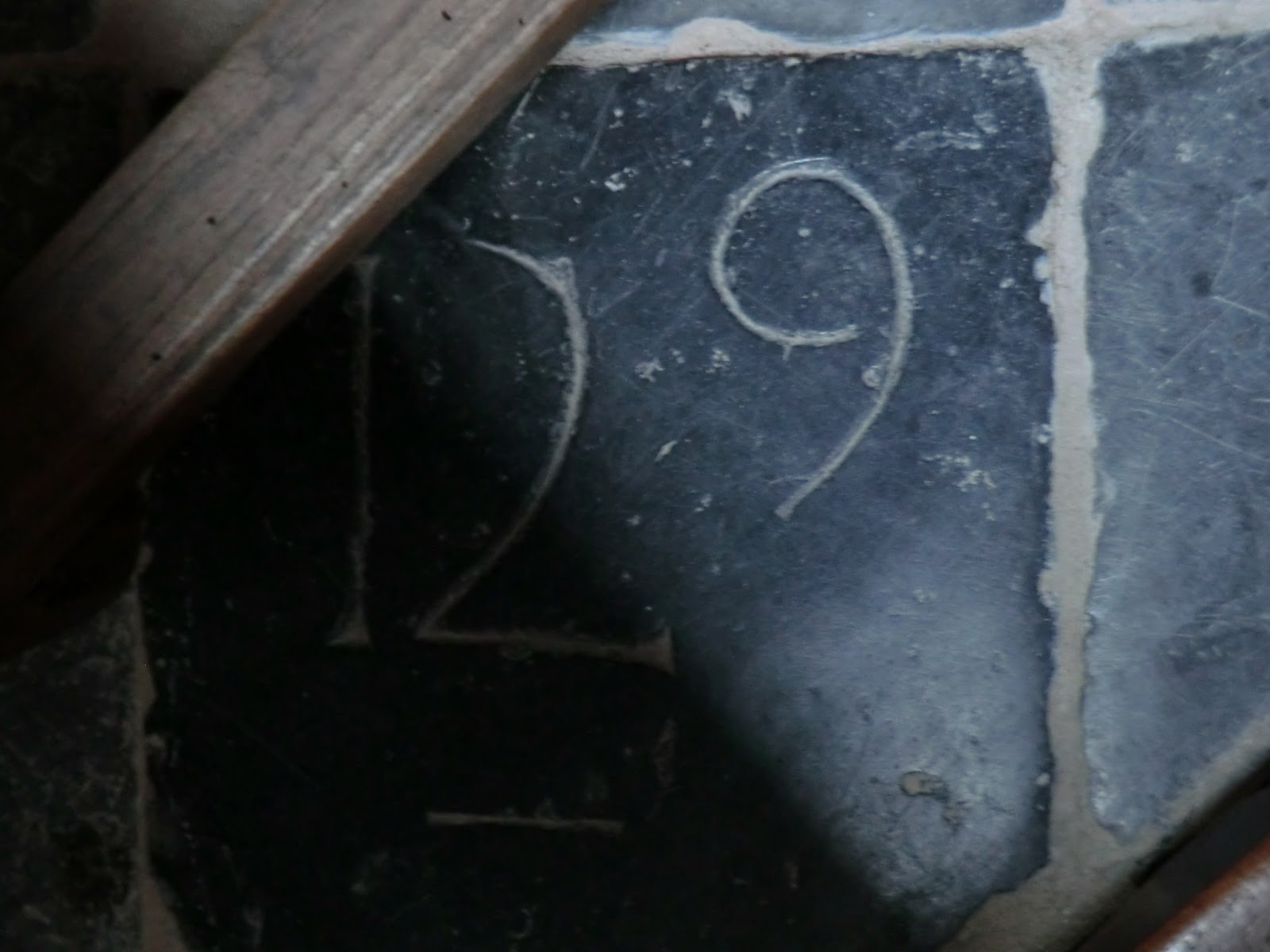
This floor is made of gravestones of priests buried at the church across the way.
Burials and cemeteries are not popular in The Netherlands.

This floor tile/former gravestone still displays a marking.

We walked to nearby Levendaal, the street where Francis Cooke lived before sailing on the Mayflower.
It is a short street with just a few structures standing on one side.

The middle of Levendaal.

The other end of Levendaal.

The modern corner structure is a synagogue.

This seems to be the oldest house left standing on Levendaal.
It is not known which house Francis Cooke lived in, as houses were not numbered until the 1800s.

Thursday, February 7, 2013

Tussenvoegsel


Amsterdam, Netherlands phonebook


Listings for Hoof, van der Hoof, and van Hoof

Where do you find van der Hoof in a Dutch phonebook?  Under H with Hoof.  This is important to remember when searching for names that begin with VAN DER, VAN DEN, VAN DE, VAN, DE, DEN, DER, HET, 'T [abbreviated form of HET].  The Dutch term is tussenvoegsel, which means "in between addition."  In the United States and the earlier colonial period, the tussenvoegsel may have combined with the last name and be alphabetized under V or D instead of H.  Best to look in many places.

And if you see "bij of meergenaamd" within a name, this means "additionally named."

Greetings from Amsterdam!

I am in Amsterdam, Noord Holland, The Netherlands.  My sister Kim lives here.  The weather is just above freezing and rains, snows, hails, clears up, and then repeats the cycle.

Today Kim showed me actual Dutch architecture.  This will help me better identify Dutch Colonial structures back in New Jersey and New York.

Note the ornate black muurijzer (wall iron).

A muurijzer anchors a support beam for an upper floor and runs from the front facade to the back facade.

The thin verticle black muurijzer above the center window is more typical of the understated Dutch style.

Buildings are made of brick.  Both the length and the width are seen because bricks are laid perpendicular to one another to form a thick, sound outer foundation to the structure.

The heavy layers of bricks cause excess moisture build-up.  Look for a small  metal tube protruding slightly to ventilate.

Stadsherstel (city restoration)
This sign on a building indicates that the building is historical and the exterior may not be altered.

The wide doors probably indicate that this structure was a barn.  Existing shutters cannot be removed.

Window shutters on a historical building.

This historical building is now a clothing store.

The hook on the wall must remain, even though nobody needs to hitch a horse anymore.

Note the support beam that runs from front to back.

Bikes are the preferred method of transportation.
Compare this row of parked bikes to the traffic congestion in Nieuw Amsterdam (Manhattan).

Dutch house under construction.
This structure is unusual because it is free-standing/not attached to another structure.

KinderKookKafe
Modern-day business in old barn.

Note that the muurijzer on the left is missing and replaced by a sort of plug.

Old hook to hold open the large door.

Newer hook to hold open the door.

More to follow . . .

Monday, February 4, 2013

Amanuensis Monday: Faded Leaf

Continued transciption of the papers found in the BISHOP family file at the New York State Library in Albany.


Olive, wife of David Barker, died Dec 23, 1837 at 27.

Ruthene, wife of Simeon Barker, died Feb 2, 1868 at 52.

"We saw her fade as fades the leaf.
And sorrow filled our every heart.
To think, from her we loved so much.
So soon we should be called to part."

Joshua Coleman die Jan 16, 1891 at 64.
Amaranca, his wife, d May 3, 1893 at 66 yrs

James Coleman d Sept 21, 1856 at 74.
Lucretia d Nov 15, 1831- 64.

Elwin Stetson- worked for board when boys.  Lived to be 89 years.
Uncle Geo lived to be 90 years.


Monday, January 28, 2013

Amanuensis Monday: Memos in a bible

Ongoing transcriptions of papers found in BISHOP family file at the New York State Library in Albany.

Original copy.

Enhanced view of photocopy.

Richard W Bishop was killed in the battle at Plattsburg 1814.

Elisha Blinn Jr was killed by the cars in 1847.

April 4th 1855 adopted Helen Winn into the family.

Thanks to Elsie Saar for posting their headstones at Find A Grave.


Online catalog for the New York State Library

Fortunately, letters and the diary of Richard W Bishop survived and are housed at the New York State Library.


Because Elisha Blinn "was killed by the cars," I sought a newspaper article.  This blurb from the Weekly Eagle in Vermont characterizes Mr T Blinn as unable to hear or speak.  He was struck from behind by the train headed to Albany.  It took a few hours for him to die.  Perhaps this was his ride home.  I wonder if he was alone and how his family found out that he had been in an accident.

Monday, January 21, 2013

Amanuensis Monday: Blinn and Bishop deaths in family bible


Transcription of contents of Bishop family file at the New York State Library in Albany.


Family Record:  Deaths.

Mr Richard Bishop died September 15th 1814 aged 33 years at Plattsburg Clinton Co N. York.

Mrs Abigail Bishop died in Austerlitz Col Co New York aged 60 years 5 months June 9 1852.

Carolina Bishop wife of Ashley Blinn, died at Albany, March 14, 1893, aged 82 years.

Mr Elisha Blinn died October 7 1835 in Austerlitz Col Co NY.  Aged 82 years 6 months.

His wife Loisa Blinn died September 17 1848 in Austerlitz Col Co.  Aged 85 years 7 months.

Mr Elisha Blinn, Jr died September 10 1847 in Chatham Col Co NY.  Aged 60 years 7 months.

Ashley Blinn died November 1866.  Aged 76 years

Helen, adopted daughter of Ashley and Caroline Blinn, died February 1 1863.


Here is this family in the 1860 United States Federal Census, living in Austerlitz, Columbia County, New York.  Hellen was 14 years old when she died in 1863.  Ashley Blinn, the father, died three years later in 1866.  Caroline lived 33 more years.  Thank you to Elsie Saar for using Find A Grave to post these headstones in Red Rock Cemetery in Columbia County, New York.


1860 United States Federal Census
Austerlitz, Columbia County, New York
Ancestry.com

Friday, January 18, 2013

Ancestry Composition

Among the new genealogy tools at 23andMe is the Ancestry Composition.  This tool presents the DNA that you have that is very similar to the DNA of people in other parts of the world.  Because both of my parents have tested at 23andMe, I can show my DNA broken down into the half from my mother and the half from my father.


23andMe
Ancestry Composition for Me
in relation to both of my parents

Both my parents are essentially of European descent.  My father's tree is mostly Colonial American with a splash of German and Irish.  My mother's tree better illustrates my composition.  My 22% British and Irish from my mother's side is most likely because of my maternal grandmother, Jeannette ODonnell.  All of her ancestors trace back to Ireland by the mid 1850s.  My 11.7% Ashkenazi is likely from my paternal grandfather's father.  What makes me think this?  Look at my mother's Ancestry Composition by chromosome.


23andMe
Ancestry Composition by chromosome for Jody's mom

On her 23rd pair of chromosomes, XX, a woman carries no genetic information from her father's father.  IF one paternal grandparent was Ashkenazi and the other was not, then we can tell from this analysis that it was the paternal grandfather who was Ashkenazi because there is no Ashkenazi inheritance on the XX chromosomes.

Monday, January 14, 2013

Amanuensis Monday: Blinn and Bishop births in family bible

Ongoing transcription of hand-written notes found in the BISHOP family file at the New York State Library in Albany.

Births recorded in a bible.


Mr Ashly Blinn born August 29th 1790 in Canaan, Col[umbia] Co[unty] New York.
Miss Caroline Bishop born December 26th 1810 in Columbia, Herkimer Co[unty], NY.
Miss Helen Blinn adopted April 4th 1855 and born February the 22, 1847.
Mr Richard W Bishop born July the 8th, 1781 in Canaan, Col[umbia] Co[unty], N. York.
Abigail Hatch his wife was born August the 4th, 1791 in Lebanon?, Lieb? Co[unty], Conn.
[Note:  In 1791, Lebanon was in Windham County, Connecticut.  In 1850, the probable time this bible entry was recorded, Lebanon was in New London County, Connecticut.]


Saturday, January 12, 2013

Family Heirloom: The Hatchet


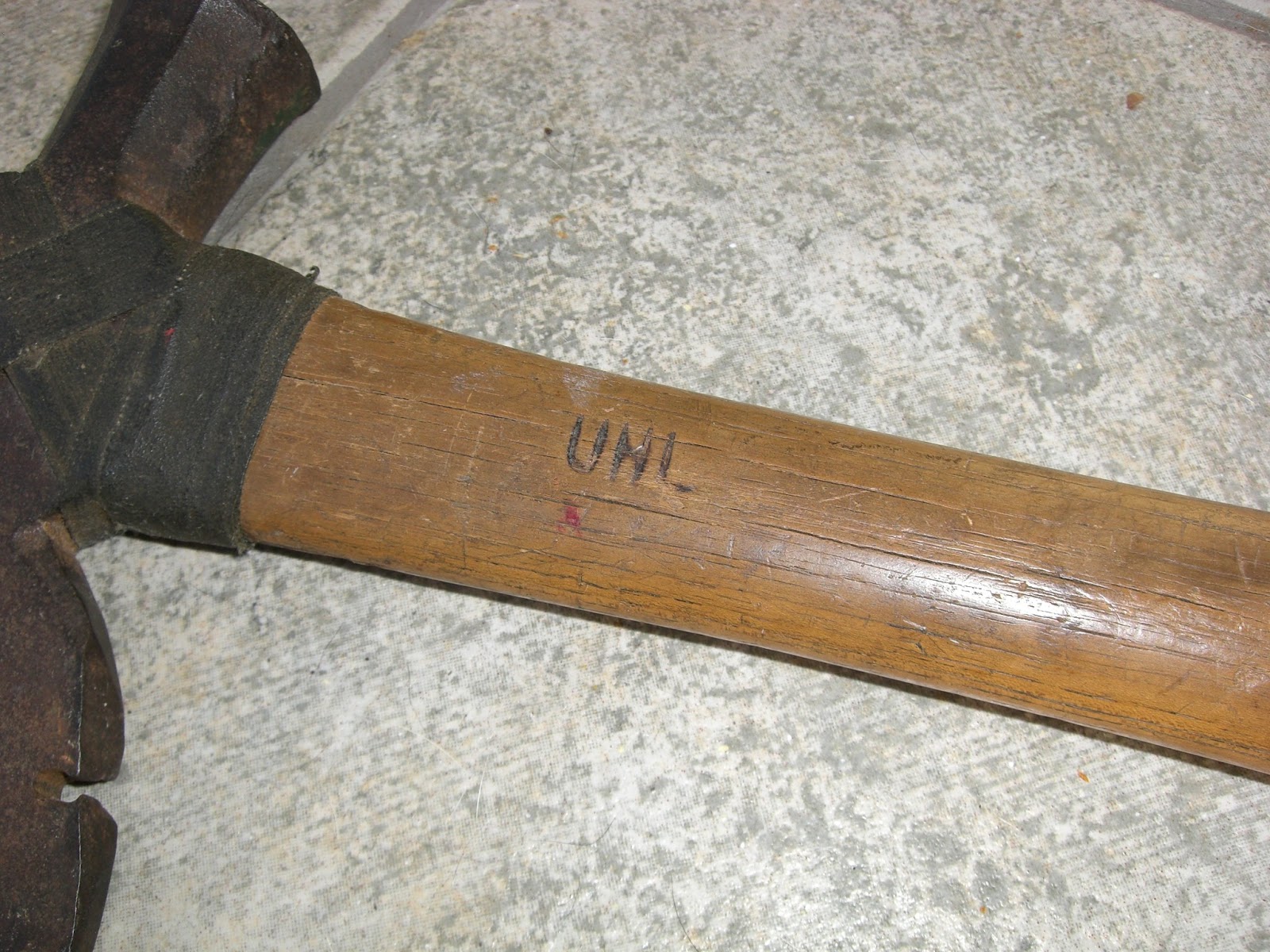
One of the possessions handed down through the generations in my family is a hatchet.  The tape was added later in the tool's life.


The letters UHL are carved into the handle.


These letters could be the last name Uhl.  My great-great-great grandfather was David Uhl.  He was a toolmaker who lived in Newark, Essex County, New Jersey in the 1850s until his death from tuberculosis in 1884.

These letters could also possibly indicate initials of my great-great grandfather, Herman Lutter.  He was a wheelwright who lived in Newark in the 1880s through the 1920s.  Herman likely had other given names.  U could be the initial for one of these names that I have not discovered thus far in my research.

Thank you, Karin, for the inspiration for this post.

Wednesday, January 9, 2013

Ancient Mitochondrial DNA

Another interesting match in the database at 23andMe!

A. H. was adopted and has no genealogy to share.  She matches my father's cousin on a small segment on chromosome 22.

Using the new Ancestry Composition feature available at 23andMe, we can see that her ancestry is roughly three quarters European and one quarter Asian.  This reflects at least five generations on all of her ancestral lines.

23andMe
Ancestry Composition of distant cousin A. H.

Previously written in the WEIRD post, most people in the database are of European ancestry.  So the first observation we can make about A. H. is that her genetic cousins at 23andMe will be of European ancestry and not Asian because that is the population in the sample.  Very few people of Asian heritage are available for her comparison.

Next we get to the maternal haplogroup of A. H.  Maternal haplogroups are named with letters and numbers and reflect ancient migratory paths tens of thousands of years ago when people lived, reproduced, and died within the same few miles of their parents and their parents and so forth.  The time before ships, trains, planes, and cars could quickly transport people all over the world.  This is great for anthropologists.  This is not really relevant for genealogists.  Written records of genealogical value are scarce as we travel back in time; some places simply have no surviving records.  Learning your maternal haplogroup, or where one of your thousands of ancestral lines lived 30,000 years ago, is not going to help you uncover the name of Mary Thompson's husband whom she married in between the 1870 and 1880 census.

Current DNA analysis of mitochondrial haplogroups shows that people originated in Africa
and traveled (very gradually) across the globe.  After thousands of years,
the DNA of mitochondria gradually mutated within sequestered groups,
giving rise to different haplogroups.


The Science:  Maternal haplogroups are determined by mitochondria.  They are the "powerhouses" of cells, if you remember back to your biology class.  Mitochondria contain their own unique DNA separate from the DNA contained in the cell's nucleus.  DNA in the nucleus is reconfigured, or recombines, when sex cells are created in preparation for reproduction, with only half the cell's original DNA getting passed on to offspring.  In contrast, the DNA in mitochondria does not change except for tiny mutations that occur every few thousand years.  You have your mother's mitochondrial DNA and not your father's because the mitochondria in sperm are destroyed before or at conception.

Drawing of mitochondria.


A. H.'s maternal haplogroup is L1b1a6.  This is interesting because this is a Western/Northern African haplotype, yet A. H. has no detectable African heritage in her.  If A. H. were able to trace her direct maternal line, she would eventually end up in this area of the world.  The problem is that this may take hundreds of generations, which is not possible with the written records available to us.  No records about A. H. are available to her because she was adopted.  23andMe has provided her with her first glimpse of her origins.


23andMe

Knowing your maternal or paternal haplogroup is kind of like getting the answer, but not the equation.  We are skipping over thousands of years of genealogy not recoverable to us and seeing where one of our lines was living.


Tuesday, January 8, 2013

Confirming WEIRD

Last February, I wrote about the WEIRD situation in studies:  subjects are usually Western and Educated and from Industrialized, Rich, and Democratic countries.  This is true in the genetic genealogy testing field as well.  My father has hundred of relatives in the database at 23andMe.  My mother has thousands.  Rarely does the African-American lady whose account I manage receive any new matches, leaving her still hovering around sixty matches.

23andMe recently offered a new survey asking the people in their genetic database to report their ethnicity.

Here is the snapshot of the answers:

23andMe
Replies to the ancestry/ethnicity question.

People who identify themselves as European comprise three quarters of the database.  If you are not of mostly European heritage, you will likely not find many relatives in the database.  As more people test, additional relatives will become available, but you need to keep this in mind when you either find very few relatives or all of your relatives look European, especially if you know otherwise in your family tree.


Monday, January 7, 2013

Amanuensis Monday: 1847 Marriage of Bishop and Blinn

Ongoing transcription of hand-written notes found in the BISHOP family file at the NewYork State Library in Albany.


The writing is difficult to decipher on this negative copy of this bible record of a marriage.

Using Picasa by Google, which is free, I can invert the colors and play with the saturation and shadows to make the writing clearer.


Mr Ashley Blinn and Miss Caroline Bishop married April 14th, 1847
In Canaan, Columbia County, New York.

In the 1850 census, the couple was living in Austerlitz, Columbia County, New York.  Caroline's age was listed as 39 years, while her husband was 61.


1850 United States Federal Census
Austerlitz, Columbia County, New York
Ancestry.com