Saturday, November 17, 2012

Organize at the Scene

While researching on the recent trip to Albany, New York, I photographed lots of indexes of births, marriages, and deaths from the microfiche reader.  The top of each page listed the event type (birth, marriage, or death) and the year, but not the state.  If the desired information was near the bottom of the page, the heading was not visible.

New York State Death Index for the year 1926
on microfiche at the New York State Archives in Albany


New York State Death Index for the year 1911
A simple organizational trick eliminated confusion later.  I hand-wrote the year, type of event, and state on a piece of paper and included the information in each snapshot.  You do not want to have a great entry but no idea of its source.

Monday, November 12, 2012

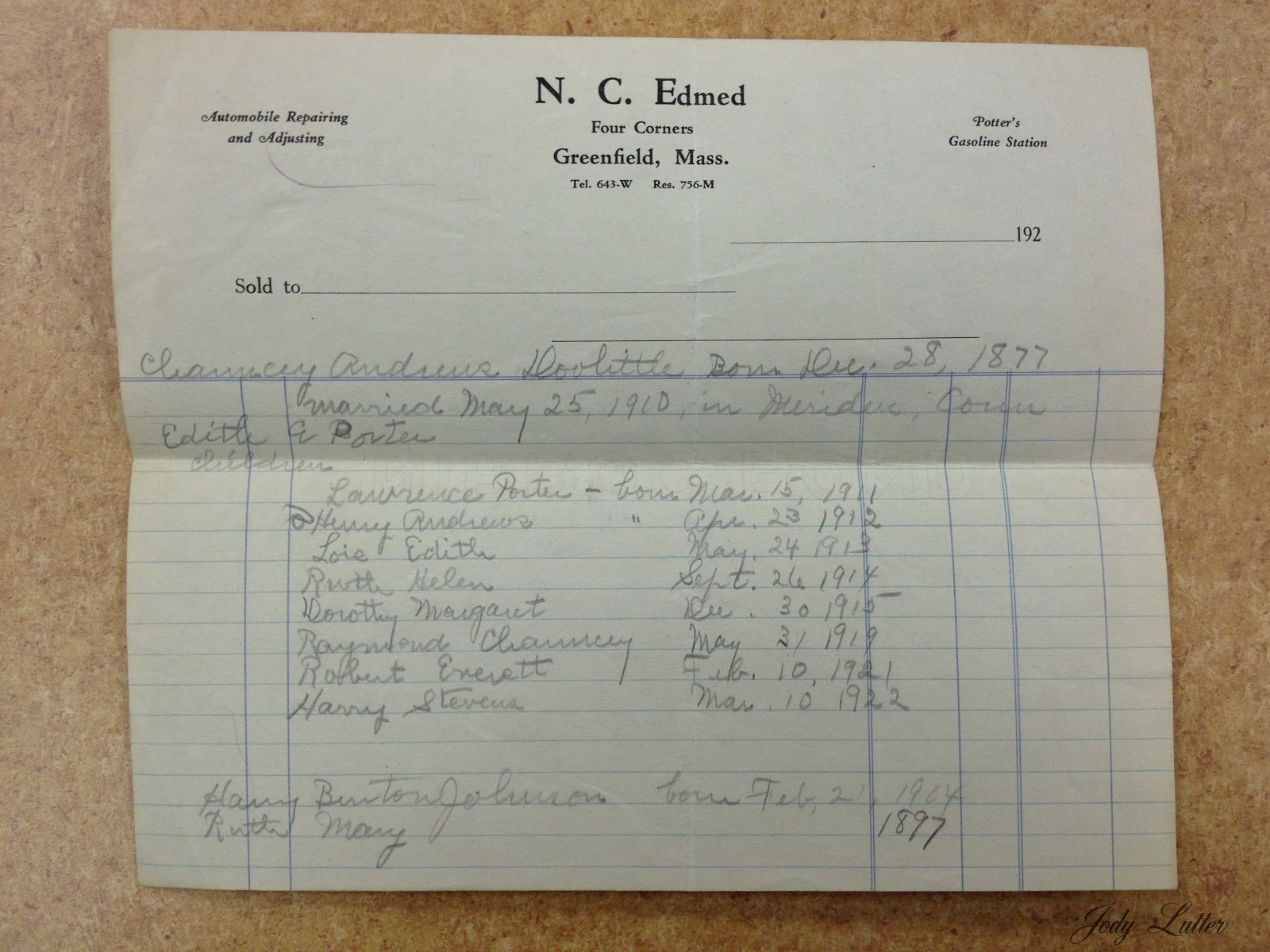
Amanuensis Monday: Doolittle and Porter of Connecticut

Transcription of Family Notes found in family file for BISHOP at The New York State Library in Albany.


Chauncey Andrews Doolittle born Dec. 28, 1877

Married May 25, 1910, in Meriden, Conn, Edith E Porter.

Children:

Lawrence Porter born Mar. 15, 1911.

Henry Andrews born Apr. 23, 1912.

Lois Edith born May 24, 1913.

Ruth Helen born Sept. 26, 1914.

Dorothy Margaret born Dec. 30, 1915.

Raymond Chauncey born May 31, 1919.

Robert Everett born Feb. 10, 1921.

Harry Stevens born Mar. 10, 1922.


Harry Burton Johnson born Feb. 21, 1904.  [Maybe Brenton or Benton]

Ruth Mary 1897.


1930 United State Federal Census
Wallingford, New Haven County, Connecticut
Ancestry.com

Sunday, November 11, 2012

Family Files at Albany

A gem to find in any library or depository is a family file.  The New York State Library at Albany houses boxes of research deposited over the decades, oftentimes not indexed or otherwise accounted for, I was told on the tour.  Contents of the files varies greatly from self-published genealogies to newspaper clippings and family bibles.  Records end up deposited at the Library for a number of reasons, such as the family historian last living in the Albany area, and not necessarily because the family had any ties to New York.

Boxes containing family files
New York State Library, Albany


Custer Family Genealogy
Self-published


Copy of hand-written notes and
Copy of marriage certificate from 1859
John Rorbach to Harriet Cook in Albany


Posterior of actual photograph of Elting Family Bible

Photograph of Elting Family Bible written in Dutch
Dates in the 1700s

Hand-written family notes concerning a Connecticut family including Bishop.
This family historian recorded information on whatever paper available.
I think I will transcribe this set of papers.

Thursday, November 8, 2012

Double Cousin

An interesting match has surfaced among my father's genetic cousins at 23andMe.  This cousin, N. H., shares three small segments with my father.  N. H. is related on both my father's paternal and maternal sides. How do I know this?

23andMe
DNA comparison between N. H. and D.W.
and N. H. and David Lutter

D. W. is my father's paternal cousin, once removed.  His DNA is so useful for sorting matches because anyone who matches both of them is related through the branch of my family tree that D. W. and my father have in common.

Here, we see that N. H. matches both my father and his cousin on the same segment of chromosome 4.  Thus, N. H. is related to my father via the paternal line.

Next, N. H. and my father share a small segment on the X chromosome.  The 23rd pair of chromosomes determines sex.  Men have XY.  The Y is passed from father to son relatively unchanged.  The X is passed from mother to son.  Thus, N. H. and my father are related through their mothers as well.  X chromosome inheritance follows a very specific path, eliminating several lines of ancestry from holding the match.

N. H. and my father also share a small segment on chromosome 8.  At this point, we cannot be sure which parent this segment can be attributed to.

Wednesday, November 7, 2012

Albany Research Trip: Sorting through the Finds

The research trip to Albany, New York lasted three days.  I found a lot of useful information.  I was unable to post because Internet service was spotty.  I refueled the car in Albany and set out for home, where electric service was coming back after Hurricane Sandy.  I was wise to stop in Albany for gasoline.  The entire way back home was dotted with lines at gas stations, growing larger and with more police cars as I approached Northeastern New Jersey.  My home suffered no real damage and the electric and heat had returned Saturday morning after going out on Monday.  The food stores were slowly receiving new shipments of perishables.  Schools were closed because they either had no electricity or were too damaged.  More people were out riding bikes or walking to their destinations.  Traffic lights were out at many intersections and large trees blocked roadways.  At this moment, many blocks in town are still without power, heat, and water- while the first snowfall, Winter Storm Athena, is blanketing last week's destruction.

One of my goals in Albany was to uncover more information about Mary or Margaret Campbell, wife of Patrick Joyce.  I have not found either of them in the 1860 census and the earliest child I can find was born in 1861.  In the 1870 census in Pawling, Dutchess County, New York, Patrick Joyce is head of a household of four children under the age of ten; no wife.  Mary Joyce is listed on the Mortality Schedule, having died in May of 1870, "Railroad run over by cars."  She is a tail in my family tree- I do not know her parents.  Growing up, I heard the story often about how the train caught her skirts and dragged her to her death- after she threw a baby from her arms to safety.


At Albany, the index of deaths for New York State begins in 1881, or eleven years after Mary's death.  No luck there. A consultation with a researcher from the New York Genealogical and Biographical Society raised an important point:  A death by train could have occurred anywhere there was a railroad- not just in Pawling.

I expanded my search of digitized newspapers at GenealogyBank (you can access from home for a subscription or use Ancestry.com) and found a small article about the incident.


According to The New York Herald-Tribune [actually called the New York Herald in 1870], Margaret Joyce died in June of 1870, not May.  The researcher was right:  She was not killed in Pawling, but about 25 miles south, in Katonah, Westchester County, New York.  She was not killed instantly, probably lingering a few days after the train severed her leg.  I can only hope she was unconscious for those last days.

It is interesting (and fortunate) that she appeared on the Mortality Schedule because only deaths before May 31st of that year should be listed.  The newspaper article places her death in June.  So we have two dates of death.

My plan of action:
Contact St. John's Cemetery in Pawling where her husband was buried in 1905.
Contact the local historical society and town clerk for records they may hold for this family.
Search through more online newspapers using keywords of "Katonah" and "Harlem Railroad."