Saturday, February 9, 2013

Amsterdam of Yesteryear Today

Today I toured the canals of Amsterdam on a boat.  Created in the 1600s, the canals helped Amsterdam grow in population and trade, enabling merchandise and people easier access to the area.  Narrow structures were built along the canals as warehouses to hold goods and to house sailors and their families.  Amsterdam requires that the front facades of these buildings be preserved, enabling us to envision how the area looked hundred of years ago.

Houses are narrow but long and tall.  The wider the house, the higher the tax.
A hook at the top of the house is used to pull up or lower down heavy items through the large windows,
a method still used to this day.

Houses did not have numbers until the 1800s.
Residences were distinguished by the design of the glass above the front door.
The lower door in the middle was for servants.

Before houses were numbered, a tradesman could distinguish his residence by a plaque.

The houses along the canals have been esthetically maintained over the centuries.
Amsterdam is below sea level.  The houses shift and lean.

Visit to the Anne Frank House

Today I visited the Anne Frank House in Amsterdam, The Netherlands.  The museum is next to the actual building where Anne Frank, her family, and four others hid from the Nazis during World War II until their discovery in August of 1944.  You can walk through the front house, which was used as a warehouse and offices by Anne's father, Otto, and then through the small door, covered by a bookcase, to enter the secret second house where the eight people lived to avoid transportation to concentration camps.  Anne wrote her now famous diary and other stories while in hiding.  Some of the actual pages, written in Dutch, are on display.  The papers were not seized by the Nazis during the raid and an employee of Anne's father safely kept them and returned them to him.  Only Otto survived.

Pictures are not permitted to be taken inside the buildings.

Knowing the fate of Anne and her family, the mood inside was sombre.  Rooms contained clips of Anne's writing, telling of the stress of the situation and Anne's fear of being discovered, which we knew became reality.

The rooms of refuge no longer contain furniture, but magazine and newspaper clippings that Anne used to decorate the walls remain.  The interior is dim and the windows blacked out to replicate the darkness and seclusion incurred by needing the drapes closed at all times.

The set-up of the house into a front and back amazes me.  The rear of the front house has windows that overlook a courtyard.  There is really no indication that several more rooms exist in the back of the house, accessible by only a tiny door, easily concealed.

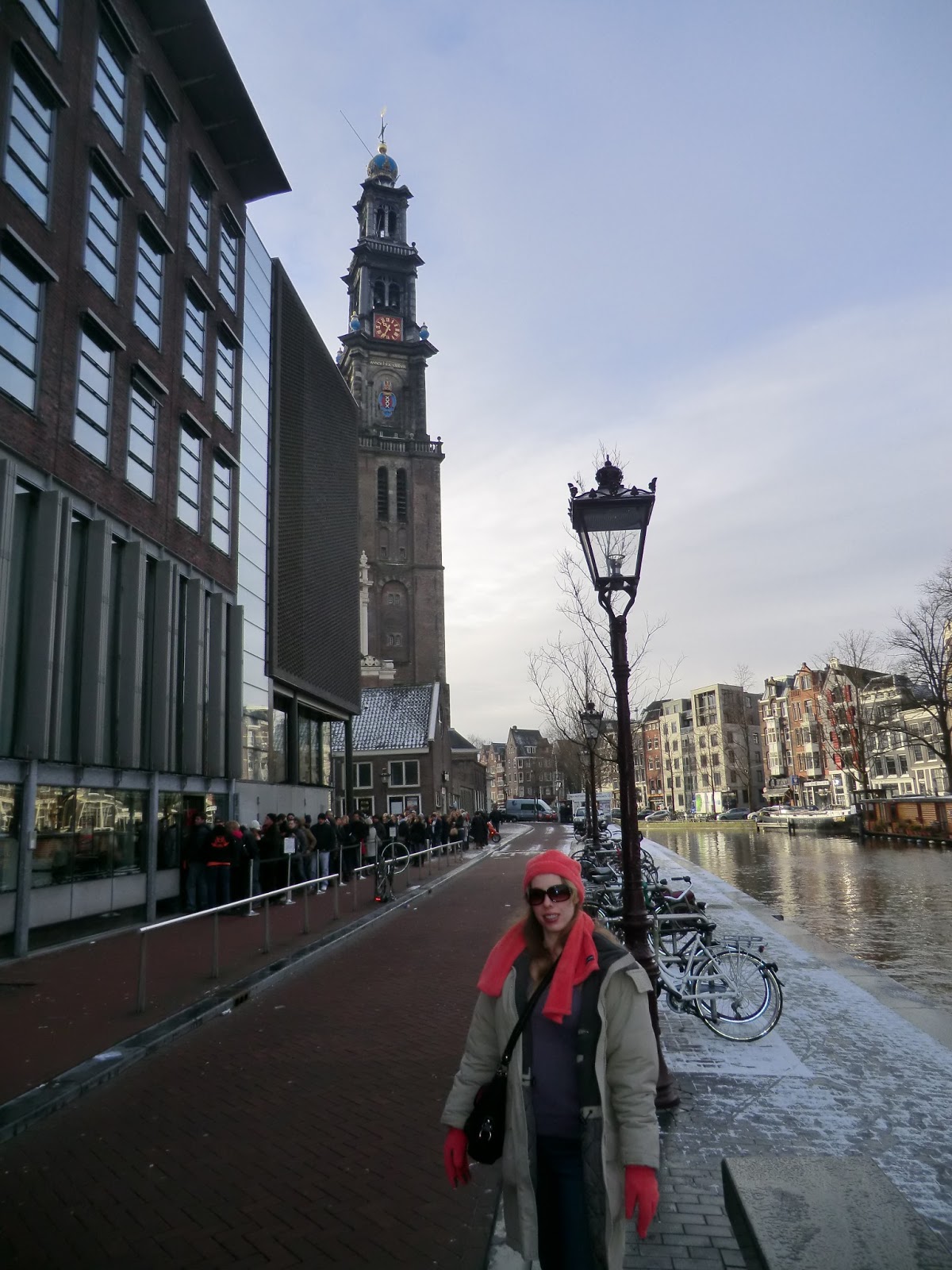
Me in front of 263 Prinsengracht, Amsterdam

Anne Frank Huis

Anne wrote about the bells of the church in the background.

A memorial for Anne Frank at the church.

Another memorial for Anne Frank in her neighborhood, Merwedeplein.

Friday, February 8, 2013

Pilgrim Museum in Leiden

Today I visited the Pilgrim Museum in Leiden, The Netherlands.  Much thanks to the director, Mr Jeremy Dupertuis Bangs, for his time and vast information that he shared with us.

Sign on the door of the Pilgrim Museum.

The corner door is the entrance to the new room.  The next door to the right is the Pilgrim Museum.

Here I am seated at a table with books older than the United States.

This is a plat book from the 1500s showing property owners in Leiden.

This book contained a copy of the marriage record of Francis Cooke to Hester Mayieu in 1603.

A jack screw was utilized to make repairs on the Mayflower.
A jack screw was recently located and is displayed in the Museum.

An identical bowl is found on the other side of the Atlantic Ocean at the Pilgrim Museum in Plymouth, Massachusetts.
I will have to visit there as well.

This is a bed.  It's so small and short because people slept sitting up in the 1600s.

People had to sleep sitting up because they burned peat for heat,
which emitted lots of black smoke, making breathing difficult.

The room next door was renovated, revealing a floor and fireplace from the 1400s.
I am sitting in a chair from the 1200s.

This floor is made of gravestones of priests buried at the church across the way.
Burials and cemeteries are not popular in The Netherlands.

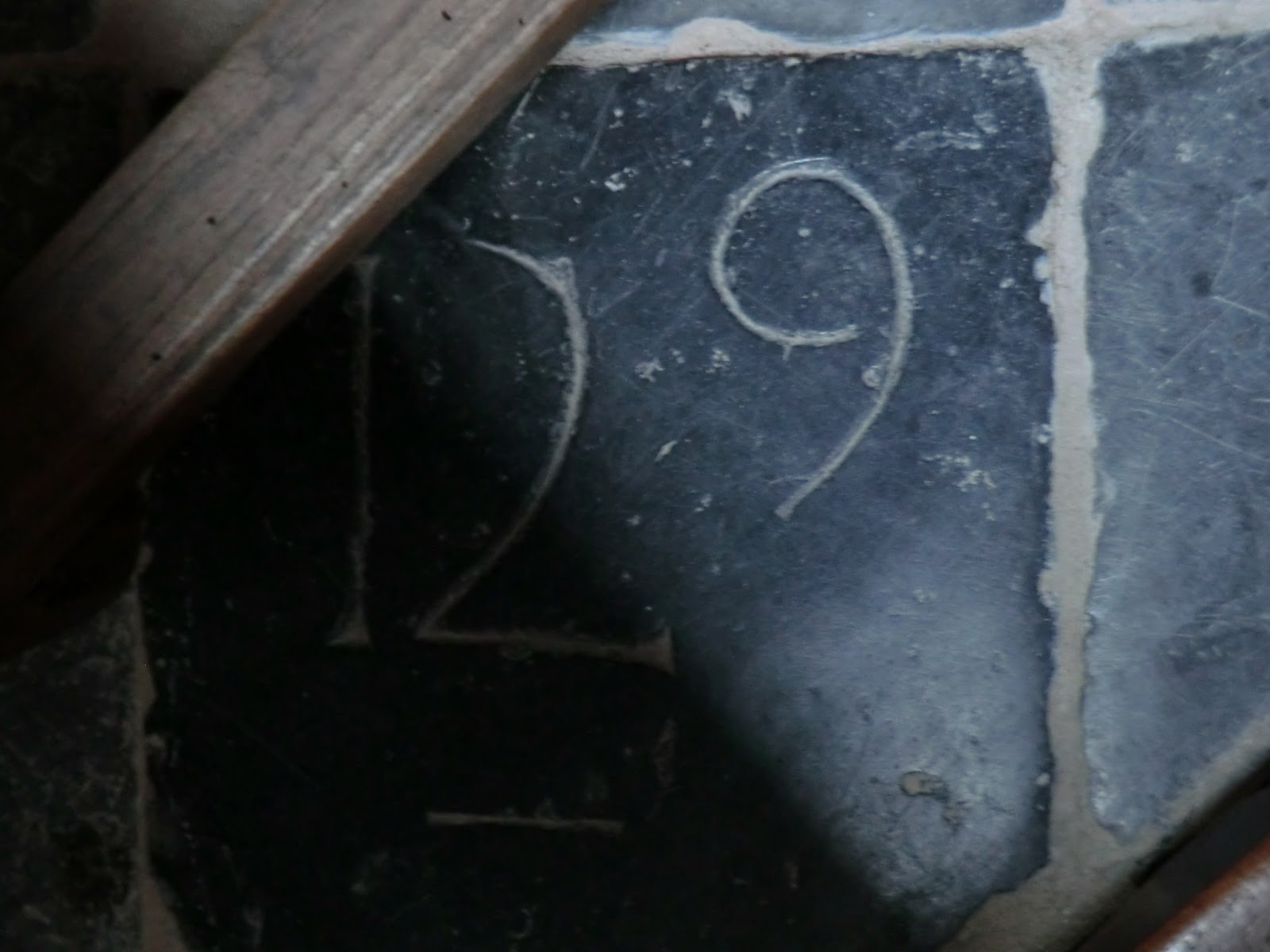
This floor tile/former gravestone still displays a marking.

We walked to nearby Levendaal, the street where Francis Cooke lived before sailing on the Mayflower.
It is a short street with just a few structures standing on one side.

The middle of Levendaal.

The other end of Levendaal.

The modern corner structure is a synagogue.

This seems to be the oldest house left standing on Levendaal.
It is not known which house Francis Cooke lived in, as houses were not numbered until the 1800s.

Thursday, February 7, 2013

Tussenvoegsel


Amsterdam, Netherlands phonebook


Listings for Hoof, van der Hoof, and van Hoof

Where do you find van der Hoof in a Dutch phonebook?  Under H with Hoof.  This is important to remember when searching for names that begin with VAN DER, VAN DEN, VAN DE, VAN, DE, DEN, DER, HET, 'T [abbreviated form of HET].  The Dutch term is tussenvoegsel, which means "in between addition."  In the United States and the earlier colonial period, the tussenvoegsel may have combined with the last name and be alphabetized under V or D instead of H.  Best to look in many places.

And if you see "bij of meergenaamd" within a name, this means "additionally named."

Greetings from Amsterdam!

I am in Amsterdam, Noord Holland, The Netherlands.  My sister Kim lives here.  The weather is just above freezing and rains, snows, hails, clears up, and then repeats the cycle.

Today Kim showed me actual Dutch architecture.  This will help me better identify Dutch Colonial structures back in New Jersey and New York.

Note the ornate black muurijzer (wall iron).

A muurijzer anchors a support beam for an upper floor and runs from the front facade to the back facade.

The thin verticle black muurijzer above the center window is more typical of the understated Dutch style.

Buildings are made of brick.  Both the length and the width are seen because bricks are laid perpendicular to one another to form a thick, sound outer foundation to the structure.

The heavy layers of bricks cause excess moisture build-up.  Look for a small  metal tube protruding slightly to ventilate.

Stadsherstel (city restoration)
This sign on a building indicates that the building is historical and the exterior may not be altered.

The wide doors probably indicate that this structure was a barn.  Existing shutters cannot be removed.

Window shutters on a historical building.

This historical building is now a clothing store.

The hook on the wall must remain, even though nobody needs to hitch a horse anymore.

Note the support beam that runs from front to back.

Bikes are the preferred method of transportation.
Compare this row of parked bikes to the traffic congestion in Nieuw Amsterdam (Manhattan).

Dutch house under construction.
This structure is unusual because it is free-standing/not attached to another structure.

KinderKookKafe
Modern-day business in old barn.

Note that the muurijzer on the left is missing and replaced by a sort of plug.

Old hook to hold open the large door.

Newer hook to hold open the door.

More to follow . . .