Monday, July 15, 2013

Guest Post: Swedish Cousins

This is a guest post written by Tom Stevens.  Our paths crossed as I was researching a Lutter branch and he was researching a Kabitzki branch in Chicago, Illinois.  Below Tom details how he uncovered the genetic relation between his great grandmother, Elna Andersson, and her second husband, Peter Emil Hammerberg.  Thank you, Tom, for sharing your family story with us and thank you for your great work on the Lutter mystery.


My great grandmother, Elna Andersson, was born October 16th, 1876, in Önnestäd, Skåne, Sweden to Anders Persson and Bengta Jönsdotter.  On October 11th, 1903 she married Victor Hugo Emanuel Wiberg in Kristianstad, Skäne, Sweden.

Elna Andersson and Victor Emanuel Wiberg

Heliga Trefaldighetskyrkan, Church of Holy Trinity, Kristianstad, Sweden
built between 1617 and 1628 by Christian IV of Denmark


Their daughter, my grandmother, Elsa Margit, was born August 8th, 1904 in Kristianstad.

Elsa Margit Wiberg


Victor and Elna divorced around 1908 and Elna was sent to live in America with an aunt.  Their daughter, Elsa, remained in Sweden and was first raised by her maternal grandfather, Anders Persson, and later by her uncle, Per Andersson (a brother of Elna).

In 1912, my great grandmother, Elna Andersson, then living in Chicago, remarried to Peter Emil Hammarberg.

Peter Emil Hammarberg


Peter insisted they send for Elsa, my grandmother.  At age 16, my grandmother boarded a ship and immigrated to Chicago to live with a mother she barely remembered.  On her Ellis Island documents, Peter Emil Hammarberg is listed as paying for my grandmother’s passage to America.

My mother told me Peter was a wonderful step-grandfather and was somehow related to my great grandmother, Elna.  Intrigued, I explored Peter Hammarberg’s ancestry.

Peter’s World War II draft record lists his date birth as March 31, 1878 in Helsingborg, Skåne, Sweden.  According to my mother, Peter had been banished to America, like Elna.  Peter supposedly was kicked out of college in Helsingborg for getting in a fight, so his father sent him off to America.

World War II draft registration card for Peter Emil Hammarberg.
Ancestry.com


In 1900, Per (Peter) Emil Hammarberg was living with his parents and siblings in Sweden.  Below is the census for this year.  Per's father is listed as Per Persson, born in 1846.  The children have the last name "Hammarberg" instead of "Persson" or "Persdotter."  Prior to 1900, children’s last names were their father’s or mother's first name with “son” or “dotter” added.  Name Laws enacted around 1901 mandated permanent surnames uniformly passed on to the next generation.  Peter’s father chose the last name “Hammarberg” for his children.  You will soon see the origins of this new family name.  [If your head was not spinning enough with Swedish surname practices, brace yourself:  Newer laws allow people great latitude in changing names and many Swedes do so. --JL]

Swedish National Archives:  www.svar.ra.se  (subscription required)


Here is the 1890-1894 Household record for Peter’s family in Helsingborg, before the Name Laws.  In this earlier census, Per Persson is listed as born on November 8, 1846 in Nosaby, Kristianstad. Note the absence of the surname "Hammarberg."


Ancestry.com (World Membership) - Sweden, Church Records, 1500-1941


Here is Per Persson's birth record from 1846, listing his father, Per Månsson, occupation Bonde (farmer), and mother, Else Olasdotter.  They lived in the village of Hammar, in Nosaby parish, Sweden.  We now know why the name Hammarberg was selected in 1900- Per Persson used a location as a permanent surname for his children and subsequent generations.


Ancestry.com (World Membership) - Sweden, Church Records, 1500-1941


And now the plot thickens.  Here is the birth record of Anders Persson, the father of Elna Andersson (my great grandmother).  Anders Persson was born on November 6, 1833 to Per Månsson and his hustra (wife) Else Olasdotter.


Ancestry.com (World Membership) - Sweden, Church Records, 1500-1941


A photograph of Per Månsson and Else Olasdotter,
grandparents of Elna Andersson and Peter Emil Hammarberg (formerly Persson).


This is the gravestone of Anders Persson taken by my grandmother, Elsa, when she and my grandfather traveled back to Sweden in 1965. His birth year is 1832 on the stone, instead of 1833. Note that his residence, "No. 1 Hammar," is etched on the stone.


Grave of Anders Perrson, Nosaby Parish Church in Nosaby, Kristianstad, Sweden


My Mother and I visited the cemetery in 2008 and it is a beautiful church.

Nosaby Parish Church in Nosaby, Kristianstad, Sweden


Here is Per Månsson and family in the household records for 1845-1850.  The children were born in Hammar from 1831-1846.  Per Månsson's children include Anders Persson (my great great grandfather) and Per Persson, the father of Peter Emil Hammarberg.  I had to call my Mother and tell her that her grandmother, Elna Andersson, and her step-grandfather, Peter Hammarberg, were not distantly related, but rather were first cousins!  Elna and Peter did not have any children together.  Sadly, Peter Emil died in 1943 from pneumonia due to his occupation as an asbestos worker.


Ancestry.com (World Membership) - Sweden, Church Records, 1500-1941


To research ancestors from southern Sweden (Halland, Skåne, and Blekinge läns or counties) the website “Demografisk Databas Södra Sverige” or Demographical Database of Southern Sweden” is an excellent starting place.  It is free and has Swedish and English versions.

Below is Per Emil Hammarberg’s 1878 birth record found in the DDSS database website.

www.DDSS.nu


Sunday, July 14, 2013

Killed by Death

Abraham Lent Brewer was born in 1826 in Greenburgh, Westchester County, New York, to James Brewer and Mary Lent.  His sister, Rene Brewer, was my 4X great grandmother.  Abraham married Fannie Duryea.  She was a sister of Stephen Duryea, my 3X great grandfather.  (We'll save that story for another day.)

Because Abraham predeceased his wife, Fannie, their entire estate passed to her family, which helped me immensely in identifying her siblings and their children.  [This is why you need to follow siblings and not just your direct line!]  In researching this couple, I discovered that Abraham Brewer was the source of the naming of the Brewer Fire Engine Company of the Monsey Fire Department.

Yet the exact dates of death for Abraham and Fannie eluded me.

They died within hours of each other in April of 1901, according to newspaper articles.


Their gravestone at Brick Church Cemetery in Spring Valley, Rockland County, New York, listed the year of death, 1901, without a month and day.  Only the International Genealogical Index ("IGI") gave a month and day:  April 28.  Below are copies of the actual paper submissions that the IGI is based upon.  Sources are not provided!

Family Group Sheet submitted for IGI
Abraham Lent Brewer- "died 28 Apr 1901"


Family Group Record for Abraham Lent Brewer, his parents, and some siblings
Today's online version of the IGI
FamilySearch.org

I ordered the death certificate for Abraham Brewer from the New York State Department of Health.  In return I received the death certificate for Fannie Brewer, his wife, with a date of death April 28, 1901 at 3 am.  This is the same date in the IGI for Abraham's death.  If the date in the IGI were correct, Abraham would have died between midnight and 3 am on April 28th in order for Fannie to have survived him, enabling her family to collect the entire estate.

New York State death certificate for Fanny M Brewer, died April 28, 1901 in Ramapo, Rockland County.

When I was in Albany, New York last year, I checked the index of deaths myself and took another shot at ordering Abraham Brewer's death certificate.  (Unlike neighboring New Jersey records, you cannot search yourself for the certificates.)  After several months, the death certificate arrived.  His date of death as per the death certificate is April 27, 1901 at 3 pm.

New York State death certificate for Abram L Brewer, died April 27, 1901 in Ramapo, Rockland County.

Now that we have Abraham Brewer's death certificate, we can form a picture of what happened, using the newspaper articles.  Abraham died in the afternoon of April 27th.  After caring for him for at least a week, his wife, Fanny, retired to her bed and died.  Her 3 am time of death is probably an estimate after neighbors checked on her the following morning and found her dead, but reflects that the deaths were within hours of each other.  Their deaths were not on the same day/date, but rather within the same 24 hour timeframe.

The date in the IGI is incorrect by one day and further illustrates why you should be leery of certain databases as well as all unsourced information.

Friday, June 7, 2013

DNA and Adoption

Last year I used the new autosomal DNA testing at Ancestry.com for someone who was adopted.  (Happy Birthday M.S.)  I was eager to compare the services of AncestryDNA to the other companies I use, FamilyTreeDNA and 23andMe.  I was disappointed in the results at AncestryDNA because no comparison utilities were offered.  The site will compare family trees for you and identify possible ancestors in common, but I could not use this function because adopted people cannot create a family tree.

For some background, M.S. was born in 1936 in New Jersey and adopted within the first year of her life.  She knew her birth name, which enabled me to find the court records at the Office of the Surrogate of Essex County, New Jersey.  The papers contained her full birth name, her birth mother's name, and her birth mother's address.  Unfortunately the age of the birth mother was omitted.  [Note:  In 1940, New Jersey sealed adoption records, but not retroactively.  This is how I was able to walk into the records room and read this coveted information.  Most adopted people do not have this option.]

Back in the day (and it's not even that long ago), before so much was online, indexed, and just a few mouse clicks away, I had to manually search papers and microfilm for information on my German families in Newark.  The family of M.S. was of German origin and lived in Newark.  They were usually found in close proximity to my German ancestors, so gathering everyone's information was not difficult.  The paths of our ancestors literally crossed many times in the same neighborhoods, places of work and worship, with the same midwives delivering each new generation.  How ironic that our ancestors most likely knew one another and now our paths had crossed years later!

In spite of all this research, I have been unable to determine which woman in this family was the birth mother.    The older generation has passed, so nobody alive today is able to confirm parentage for us.

A DNA test can connect an adopted person to her genetic family.  At AncestryDNA, the closest relatives for M.S. were at best third cousins.  None had known lines from Germany or New Jersey.

Recently AncestryDNA enabled participants to download their raw DNA data, which had been offered for years at 23andMe and FamilyTreeDNA.  GedMatch is a free site with useful functions for your genetic genealogy studies.  GedMatch expanded to accept and compute AncestryDNA files.  I had already uploaded the raw DNA of myself and others tested at 23andMe.  I was finally able to compare my family to the DNA of M.S.  We *might* match!

I write *might* because the shared segments are smaller than the minimum length generally held to signify a common ancestor [5 cM for the genetically inclined].  GedMatch gave a predicted relationship of about 7 generations back to a common ancestor for M.S. and my father and all three of his siblings.  The results are below.  The areas marked in green are identical areas for the siblings.

GedMatch.com
M.S. versus my father.
The green area is identical in his siblings and M.S.

GedMatch.com
M.S. versus my uncle.
The green area is identical in his siblings and M.S.

GedMatch.com
M.S. versus my aunt.
The green area is shared with her siblings and M.S.

GedMatch.com
M.S. versus my uncle.
The green area is identical in his siblings and M.S.
The orange area is possibly shared with a cousin who is not related to the suspected common German lines.


In the final comparison above of my uncle to M.S., I have marked an area of chromosome 17 in orange.  This is a possible shared overlap with my father's mother's cousins.  I have not tested the DNA of any cousins from my father's German branch, which is on his father's side, not his mother's side.

GedMatch.com
M.S. versus cousin 1
The area in orange might be an area where M.S. matches this cousin and my uncle.

GedMatch.com
M.S. versus cousin 2

If M.S. matches the cousins from my father's mother's side, then this throws my German theory out because the only German in my father's family tree is from his father's father.  I think there is a better explanation.  The area of Chromosome 17 that is identical is perhaps too tiny to be significant.  These cousins match me through their father's side.  If we look at their mother's tree, which is not related to me, we find German roots quickly.

1870 United States Federal Census
New York City
Wrage household

We have another Herman the German.  Herman Wrage was the great grandfather of my two cousins who match M.S.  It is possible that they are related to M.S. as is my father, but on different German lines.  We just have to figure out those lines.


Wednesday, June 5, 2013

DNA Studies: Children of Cousins

In the previous post, I compared the amount of shared DNA between siblings.  Here, we compare the widening differences in the amount of shared DNA between cousins.

With each generation, half the DNA of the previous generation is lost.  Each parent contributes half their DNA to create a new human being.  Beginning with your grandparents, you will not inherit your DNA in precise halves.  In other words, you have 50% of your mother's DNA and 50% of your father's DNA, but not necessarily 25% from each grandparent.  The amount skews with each new child and subsequent generation.

Amount of shared autosomal DNA expected between close relatives.  The actual amounts will vary.


I am fortunate to have been able to test cousins of my grandparents.  My paternal grandfather, Clifford Lutter, only had one first cousin through his mother.  My paternal grandfather, Beulah Cook, had two first cousins through her mother.  If my grandparents were alive to test their DNA, we would expect them to share about 12.5% of their DNA with their first cousins.  Instead, the children of my grandparents (my father and his siblings) have tested their DNA.  We would expect to lose half the DNA with the next generation, placing us around 6.25% shared DNA between first cousins, once removed.  My sister and I are the next generation, so we would expect to share about 3.125% with our first cousins, twice removed.

The comparisons at 23andMe illustrate that even close relatives will share varying amounts of DNA.  Long segments of DNA are broken down in recombination, so that little DNA is identical by the time we reach the third cousin relation.


My grandfather's first cousin versus the next two generations.
The expected amount of identical DNA between first cousins once removed is 6.25%
The numbers for this group range from 6.71% to 9.25%
The expected amount for the next generation is 3.125%.  My sister matches only 2.7% while I match 4.44%


Grandmother's maternal first cousins versus the next generation.
In this set, the actual shared amount varies more widely.
The first cousins once removed share between 3.85% and 6.3%
In the next generation, my sister shares a greater percentage than our aunt and uncles,
while I share far less at 2.14%

Grandmother's maternal first cousin versus the next generation.
The amount of shared DNA among the first cousins once removed ranges from 5.64% to 8.6%
Again, my sister shares more DNA with this cousin than three members of the prior generation,
while I share less than expected at 2.95%


You see in the above comparisons that your ancestor's DNA quickly breaks up into smaller, non-identifiable segments randomly allocated down different descendant lines.  At this point, I have tested most of the known close relatives of my paternal grandparents (except for the descendants of Ruben Charles Cook and Eleanor Lovelace- hint hint).  It is not surprising that most relatives inthe DNA databases share only one tiny segment with me.

1920 Federal Census
Ruben Charles Cook and Eleanor Lovelace
Newark, Essex County, New Jersey


Saturday, May 25, 2013

DNA Studies: Siblings


Full siblings (same mother and father) will share about 50% of their autosomal DNA.

My sister and I thought that we look and act so much alike that we would test within the higher range for siblings.


We were surprised to discover that we share less than 50% of our DNA.

23andMe DNA Relatives function
You inherit half your DNA from each parent.  Full siblings will match within the 50% range.
The blue P indicates a relation through my father.
The purple M indicates a relation through my mother.
Hence, my sister has both designations.
(You can only use this function if you have a parent in the database.)


My father's siblings also submitted their DNA.  They match one another from a low of 43.6% to a high of 55.9%


And my paternal grandmother's cousins submitted their DNA.  They are brothers.  Their match is exactly 50%.

23andMe DNA Relatives function
This sibling duo shares exactly the predicted amount of identical DNA.


Remember that you have two sides to your chromosomes: one from your father, the other from your mother.  Current DNA testing does not tell us which side of the chromosome holds the match to a DNA relative.  (One of the reasons why you need to test cousins from different branches of your tree.)  When you compare full siblings, you can see the areas where they inherited the same DNA from both parents.

23andMe
The sky blue areas represent where my sister and I inherited identical DNA from one parent, but not the other.
The dark blue areas represent points where both of us inherited the same DNA from both parents.


Half siblings will match on only one side of the chromosome- the one from the parent in common.

23andMe
Half sibling comparison
The sky blue areas represent shared DNA from one parent.
No dark blue/completely identical areas because they are related on one side only.


Next up:  I will show you the cousin to cousin comparisons and demonstrate how quickly and randomly our ancestors' DNA breaks into smaller, indistinguishable segments.


Friday, May 24, 2013

Grandparents were Cousins?

John Hickman shares a larger than usual segment of identical DNA with my father, David.  The comparison at 23andMe looks like this:

23andMe autosomal DNA comparison


John caught my interest because the segment is three times larger than most of the segments that are shared with the hundreds of other DNA cousins.  In addition, he resembles my father and he is a lawyer who teaches politics- some of my (other) interests.

John Hickman is exploring whether his Hale line is related to Nathan Hale (1755-1776).  Nathan Hale is believed to not have had issue before dying at age 21, so if John's Hale is related to Nathan, it is through one of Nathan's ancestors.

My paternal grandmother, Beulah Cook, was descended from Solomon Brewer (1746-1824).  Nathan Hale was the second cousin, twice removed of Solomon Brewer.  Their common ancestors were John Strong (1610-1699) and Abigail Ford (1619-1688):  Great grandparents of Solomon Brewer and 3X great grandparents of Nathan Hale.

We need a paper trail connecting John Hickman's Hale line to Nathan Hale's line.

In the meantime, I tested my some more relatives.  Surprise!!!  A first cousin of my paternal grandfather shares a segment of DNA with a first cousin of my paternal grandmother.

23andMe autosomal DNA comparison
between my father's paternal cousin and his maternal cousin.
They match.  The question is HOW.


This is the same segment of DNA where John Hickman matches my father, so we compare John against my father and my father's maternal and paternal cousins.  John matches all of them.  The comparison at 23andMe looks like this:


23andMe autosomal DNA comparison.
John shares an ancestral line with David, David's paternal cousin, and David's maternal cousin.
The question:  which line?


This gives us some options: 
---The connection is still the Strong/Ford/Hale/Brewer ancestors- and unknown to us at this time, both of my father's parents are descended from these lines; OR
---The connection is through a different line- but still indicates that my grandparents were their own cousins; OR
---The connection is through lines of the maternal lines of the first cousins, which are not related to my father.

The common ancestor is someone I have not uncovered- someone waiting behind a brick wall.  Many of these ancestral lines lived in the same geographical area, so it is entirely possible and perhaps likely that the lines linked up in the past, split, and then rejoined when my grandparents married.

This is why I say that DNA testing gives us the answer first; we have to figure out the equation.

And it is John Hickman's DNA- a cousin of unknown relation- that provides us with the link between the families.

John is also a published author with his recent book, Selling Guantanamo: Exploding the Propaganda Surrounding America's Most Notorious Military Prison.  I find it fascinating how so many relatives are also researchers and authors.  John is especially fascinating because our potential common ancestors were deeply involved in the politics of their day.  Their actions created the records we use today to document our genealogies.


Tuesday, May 21, 2013

Mystery Third Cousin of a Third Cousin


Inevitable at the DNA testing companies are those close matches who won't answer your requests/pleads for contact and information.  Here is one such match for my Known Third Cousin.

Nestled among my Third Cousin's highest matches (my father and his siblings) is this mystery cousin.  You can see that she lines up beautifully as a third cousin match.  I'm not saying that she matches my father or his siblings.  The match is to my Known Third Cousin- one of his sixteen great great grandparents is one of hers, or a sibling to hers.  Finding someone as close as a third cousin in the genetic database is a great boon to your research and helps you assign distant genetic cousins to a branch of your family tree.


23andMe Relative Finder/DNA Relatives
Top genetic matches for my Known Third Cousin


Monday, May 20, 2013

DNA Matching with a Third Cousin Revisited

DNA results are arriving for multiple family members who recently tested at 23andMe.  Processing and analyzing them is time-consuming.  Challenge Accepted.


First up for discussion is one of the first people to submit his DNA, my father's third cousin.  (Happy Birthday!)  Third cousins share a pair of great great grandparents; in this situation, Calvin Cook and Mary Neal, both born around 1830 in Morris County, New Jersey.  Once we reach the third cousin level of relation, the chances of sharing any identical DNA begin to decrease.  If third cousins do match, the percentage will be around 0.78% (watch the decimal) over two to six segments.

International Society of Genetic Genealogy


We lucked out and my father and his third cousin match within the predicted range:  0.93% over two segments.

23andMe autosomal DNA comparison between third cousins.
They share identical DNA on chromosomes 13 and 21.


The value in this information is uncovering which segments in the genome of my father and our third cousin could be attributed to Calvin Cook or Mary Neal.  As more people submit their DNA and compare their genome to ours, we can find matches.

23andMe autosomal DNA comparison
of two known third cousins
against two others who match both of them on the same identical area

These distant cousins match both my father and his third cousin on the same segment of their DNA.  This predicts that if we travel backwards in all of our family trees, we will find an identical branch, or the Most Recent Common Ancestor.

Finding the elusive Most Recent Common Ancestor is not easy.  Most distant cousins in the database do not have extensive family trees.

My father's three siblings tested their DNA.  Fortunately, all three also match their third cousin- with more DNA.  The amount of matching varies, but is still within a third cousin range.


23andMe autosomal DNA comparison
Relative Finder/DNA Relatives function
Four sets of known third cousins


23andMe autosomal comparison
Three siblings versus known third cousin.
The segments circled in red are segments newly identified as Cook/Neal genetic material.
All three siblings provide more matching DNA than the original comparison with my father.


My father's siblings share the two segments shared between my father and their third cousin, in addition to several other segments (marked in red in the screenshot above).  I can now identify these additional segments as Cook/Neal DNA in my father's siblings and their third cousin.  This enables me to identify more people in the database who share ancestry within our specific Cook/Neal branches.  This is especially important because Mary Neal is a "brick wall" in our family tree:  We do not have her parentage.  I suspect she is of Irish ancestry and am not surprised to find that most matches in common among my father, his siblings, and their third cousin are in Ireland.

Next, we consider the DNA shared between this third cousin and the next generation:  My sister and me.  Our relationship is called Third Cousins, Once Removed.

23andMe autosomal DNA comparison
between two siblings and known third cousin, once removed

I share no DNA with my third cousin, once removed, while my sister shares one small segment.  This is entirely possible and demonstrates how little DNA, if at all, you share with distant relatives.


Now here is where you can and will run into trouble with your DNA comparisons.
Let's say that my parents and their siblings were not available to test.  This is a very real situation for most of you reading this.  After finding no shared DNA between me and this third cousin, once removed, we might question our records and wonder if we had a non-paternal event in our lines.  Next my sister tests and are relieved and thrilled to find some shared DNA.  Looking at my sister's small segment shared with this third cousin, once removed, we would incorrectly conclude that this little segment is Cook and/or Neal DNA.  The segment shared between my sister and our third cousin is not from our father, but rather from our mother and is likely not Cook or Neal DNA.  (Leave open the possibility that our mother is related to Mary Neal, our father's great great grandmother.)

23andMe autosomal DNA comparison
Known paternal third cousin versus father/mother/child trio.
The green segments represent third cousin matching.
The blue segments represent a match to a distant cousin, passed on to the next generation.

Fascinating, isn't it?  Our father's cousin is also our mother's cousin!  Our father shares two large segments of DNA with his third cousin and we inherited none of it.  The small segment shared between my mother and my father's third cousin is inherited by my sister only.

Testing more cousins on our mother's side should help assign this double cousin to a maternal branch as well.  (Hint hint.)


Tuesday, May 14, 2013

Family Bible for Sale

Another great eBay find:  Duryee family bible.  Reminds me of the Duryee pictures for sale a few years back with the same price tag:  $1200.  The hefty fee has to do more with the edition of the bible and not the invaluable genealogical information etched inside.

This appears to be from the John T Duryee and Nancy Mumford branch.  They were married around 1797 in New London, Connecticut.  [You can find different dates online, but don't get me started.]


eBay.com
Listing for Duryee family bible


Friday, May 10, 2013

Woodland Cemetery: Damage and Neglect Prevents Safe Day 2013

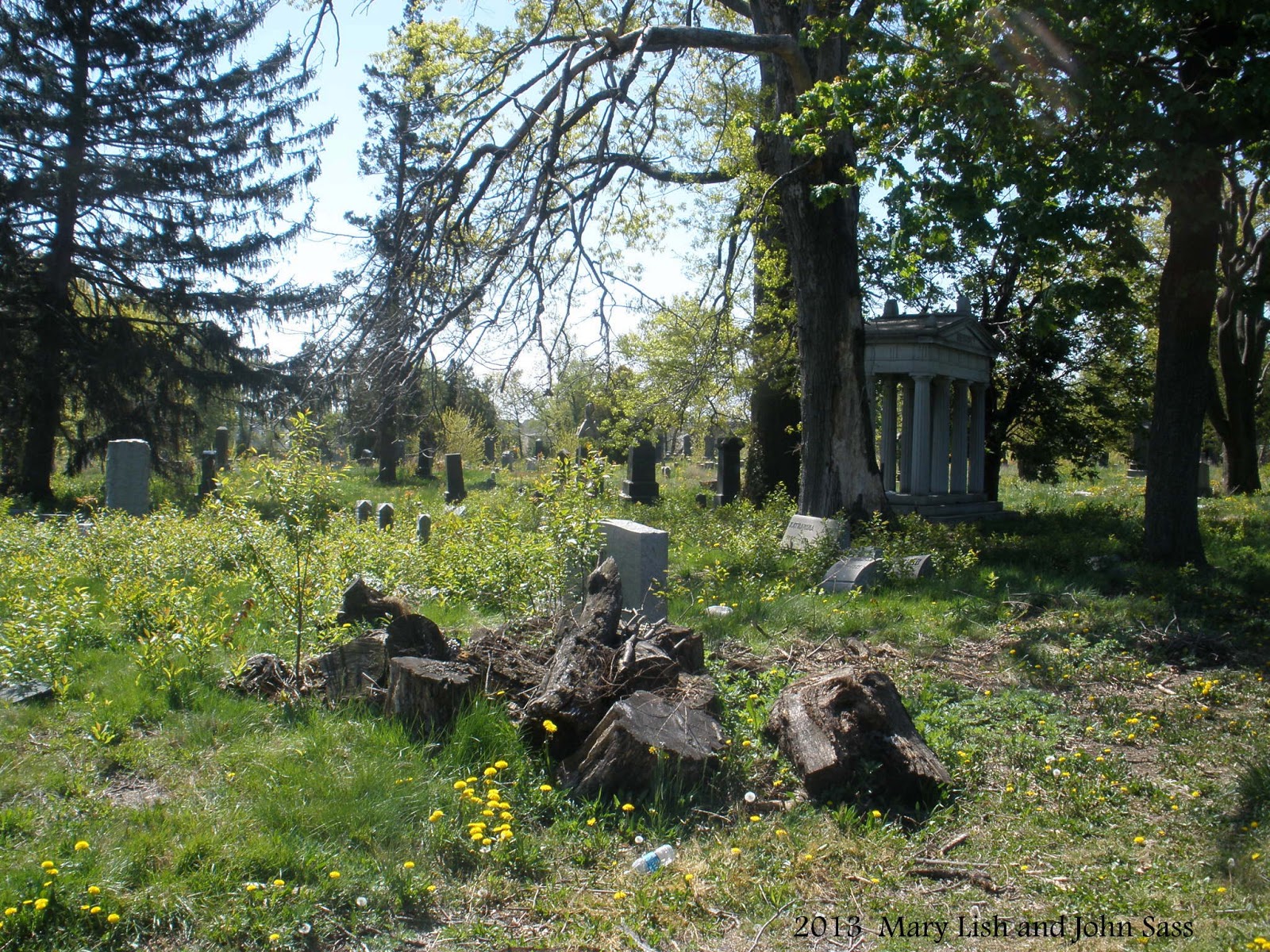
Woodland Cemetery in Newark, Essex County, New Jersey suffered damage last October during Hurricane Sandy.  Every year, a group visits Woodland in June to document headstones, called "Safe Day."  There is no caretaker on site and no physical barrier (other than overgrown vegetation, fallen trees, and garbage) to preclude entry into the Cemetery day or night.  The surrounding area is marked with violence.  Over the years, headstones have been stolen, moved, and damaged.  Litter is strewn about.  In spite of some conservation efforts, the Cemetery remains in disrepair.

Mary Lish and John Sass lead the effort to record the remaining headstones and establish a more reliable map for Woodland.  They visited Woodland on May 5th and shared photographs.  The landscaping has not been cleared since my visit in April.

Mary wrote, "With regret, after 15 years, we are forced to cancel this year’s Safe Day due to the condition of the cemetery.   The grass has not been cut since Safe Day last year, June 2, 2012.  To make matters even more difficult, Hurricane Sandy brought down multiple trees and tree limbs all over the cemetery.  Some of the trees have been cut down, but the wood has not been removed.  We do not feel it is safe to walk in the cemetery – you cannot even tell where some of the roads are since everything is so overgrown."

It is a shame that some people have desecrated the final resting place of my ancestors and that the deterioration is allowed to compound.


Woodland Cemetery, Newark, Essex County, New Jersey
May 2013

Woodland Cemetery, Newark, Essex County, New Jersey
May 2013

Woodland Cemetery, Newark, Essex County, New Jersey
May 2013

Woodland Cemetery, Newark, Essex County, New Jersey
May 2013