Sunday, February 2, 2014

Delayed Birth Certificates

New Jersey has an interesting collection of Delayed Births 1848-1900 at the Archives.  Because everyone did not record a birth with the local registrar, and this birth may or may not have been recorded at the state level, some people had to request that a birth certificate be created- years after the event.  The accuracy of a record made years later is suspect.  These applications for a delayed birth certificate required information and documentation not required for the original birth certificate.  You can use the information to locate additional records.

Delayed birth certificate for Henry Bossett, born in Newark, New Jersey on February 3, 1896.

This is a birth certificate created years later; in this situation, 46 years later.  The helpful information contains an address at the time of birth as well as full names of the baby and parents.  We get a signature of the father as he attests that the birth occurred at the specified date and place, as well as his current address.

But that's not all.  The applications for the delayed birth certificate are also filmed.

Application of Henry Bossett to issue a delayed birth certificate

The application asks for:
--Date and place of marriage of parents.
--Names, dates, and places of birth for other children of this union.  (Some forms ask only for children born earlier than the person now requesting a birth certificate.)
--Name, date, and place of marriage of the applicant.
--Street address used in the 1905 and 1915 New Jersey state census!

While this information is great, you need to consider the information provided in light of other records.  By the 1940s, when this record was created, this family was spelling their last name with two Ts:  Bossett.  In 1896, the spelling was Bossert or Bosset.


One other sibling, Mary, is listed on the application.  This couple had three children, the first born in 1894.  The omission of this first sibling perhaps indicates that the surviving children did not know about this first child.


Delayed birth certificate for George Cowenhoven Duryee, born in Hudson County October 23, 1899
George Cowenhoven Duryee attested to his own birth.  Documentation, which is not on the microfilm, was a baptismal certificate from a church.  You can use this information to possibly locate church records for this family.  (Several members of this branch are buried at the cemetery for this church.)  We get the full names and towns of birth of the parents.

Application of George Cowenhoven Duryee for a delayed birth certificate
The application for the delayed birth certificate shows us that this family's records lie in both New Jersey and New York.

I would also like to point out some of these place names.  Union Hill existed in 1894, but along with West Hoboken, had become Union City before this record was created in 1943.  These locations are in Hudson County, not Union County.  North Bergen is in Hudson County, not Bergen County.  "Town of Union" in Hudson County is where we can go astray.  By 1899, this town had been broken up and morphed into other other towns, some of which were later annexed into other towns and/or changed names.  Hudson Heights is currently a neighborhood of North Bergen.  So most of these locations are challenging to pinpoint given the border changes, name changes, and non-contemporaneous record making.


Next for review is the delayed birth certificate for someone who already had a birth certificate.

This is the birth certificate of Anna Augusta "Gussie" Lutter made at the time of her birth in Newark on April 29, 1892.

Yet Augusta filed for a delayed birth certificate.

Delayed birth certificate for Anna Augusta Luther, 1892

It looks like Augusta thought she was born in Harrison in Hudson County on April 30, 1892.  She had the wrong city and county and was off by one day.  In addition, she was spelling the surname as "Luther," which was a spelling used by the family, but Augusta's original birth certificate appeared in the index as "Lutter."  We would know to look under both spellings, but without a first name at birth, Augusta may have been told that her original birth certificate did not exist.

Index to New Jersey births, 1890-1900
Available at New Jersey State Archives and FamilySearch.org (microfilm)


Sunday, January 26, 2014

Two wives named Anna

In your research you may get snagged by the Two Wives, Same Name situation.  One wife dies and the husband remarries to a woman of the same first name.  You may not realize that you are dealing with more than one wife or you may mix up records of one for the other.

Let me use Charles Lutter as an example.  Charles, also known as Carl or Karl, was born in the 1860s in a German area of Europe and settled in Newark, Essex County, New Jersey as a child.  To add confusion, there appears to be two contemporaneous men of this name and age in Newark, plus other men in later generations with this same name.  I am still sorting these lines.

Charles had a son named Elwood Lutter (1905-1989).  This is a rather unique name among the Lutters and easier to trace.  I especially remembered this name because many years ago, someone from Salt Lake City called my home, seeking information on Elwood and the Lau family.  (I think my father is one of the few remaining people in Essex County using the surname Lutter.)


In the past, applications for Social Security numbers were cheap and easy to obtain.  Elwood's application cost $7 and provided me with the names of his parents, Charles K Lutter and Anna Lau.


This family is seemingly easy to identify in the federal census from 1900 through 1930 by searching for Elwood or his siblings, Elizabeth, Florence, Charles, and Robert.

1900 United States Federal Census
Parents Charles and Anna of Germany; children Lizzie, Florence, and Charles.

1910 United States Federal Census
Parents Charles and Anna of Germany; children Elizabeth, Florence, Charles, Elwood, and Robert.


The 1920 census is quirky.  First, the family is in no longer in Newark, but rather in Keansburg, which is in Monmouth County, New Jersey.  Also, Anna's birthplace has changed from Germany to New Jersey.  This is accurately carried over to the children's rows- mother born in New Jersey.  In addition, Anna's mother, Minnie or Wilhelmina, is living with them, with a last name of FREY.  Not quite LAU, but this is okay.  I've seen wackier entries in the census.
1920 United States Federal Census
Lutter Charles with wife Anna; children Elwood and Robert; mother-in-law Minnie Frey.

In the 1930 census, the family is back in Newark, minus the mother-in-law.  Anna's birthplace is still New Jersey.  There is a discrepancy with the marriage information.  Charles is 7 years older than Anna; but he was first married (does not mean to the listed spouse!) at age 20, while Anna was 30 years old at her first marriage.  With these numbers, their first marriages were not to each other.  But I've seen far greater discrepancies that were simple attributable to errors in the census.
1930 United States Federal Census
Lutter Charles, wife Anna, son Robert.

So I was proceeding with this branch when I was contacted by the Frey family, inquiring of Charles Lutter and his family history.  There are online family trees naming the wife of Charles Lutter and the mother of the five children as Anna FREY.


Great to hear from the Frey family.  My question:  Why did Elwood Lutter list his mother as Anna Lau and not Anna Frey?  Answer:  Don't know.

More research required.  I looked for the birth certificates of the five children born to Charles Lutter and wife Anna.  I found four of them.  All listed the mother as Anna Lau, not Frey.


My first thought was that I had mixed up the two men named Charles Lutter.  I thought that the other Charles Lutter had died in 1912 and was buried at Fairmount Cemetery in Newark.

The other possibility was that the first wife died and Charles remarried to another woman also named Anna.  This would have occurred between the 1910 and 1920 census recordings, when Anna's birthplace "changed" from Germany to New Jersey.

These Lutter branches are not lacking in women named Anna.  I had plenty of women to reconsider if Anna Lau/Frey had not lived to see the 1920 census.  In a grave at Woodland Cemetery in Newark, marked only with a blank white stone and one marked stone, I had a good candidate:  Anna Lutter, died 1914.  Only her stone, fallen flat on the ground, remained in this Lutter plot at Woodland Cemetery.

Woodland Cemetery, Newark, New Jersey
photo taken June 2, 2007 by J Lutter

Anna Lutter
Mar. 14, 1869 - Oct. 21, 1914
Woodland Cemetery, Newark, New Jersey
photo taken June 2, 2007 by J Lutter

Next I located the 1914 death certificate for this Anna Lutter.  She was indeed Anna Lau.

1914 death certificate for Anna Lutter, nee Lau
Very poor copy.


I have not found a marriage record for Charles Lutter to either wife.  Charles would have married Anna Frey after the death of Anna Lau in 1914 and before the 1920 census.


Anna Frey with her family of origin in the 1880 federal census.
24 Action Street, Newark, Essex County, New Jersey

When someone's wife changes her information, but not her name, from census to census, you may want to consider a remarriage to another woman with the same given name.

Wednesday, January 22, 2014

Birth Corrections

People can "correct" a birth certificate years later.  They can change names, dates, and locations.  Always be on the watch for a correction to any record.  When viewing images, this correction may be filmed before or after the original record, or you may have to search a different collection.

Naturally, discrepancies result in changing any official record.  You need to consider the original information as filed and weigh it against the "correct" information and when the amendments were requested.  Most of the corrections I see where not made around the time of the event.  You need to look not just at the information provided and changed, but when the changes were sought and figure out the motive.

I usually find corrections to names.  This includes giving "Baby" a first and middle name.  (Yes, you could have a birth certificate issued for "Baby.")

Birth certificate for Gertrude HERZIG, born November 10, 1904 in Newark, Essex County, New Jersey.
Copied at the New Jersey State Archives by J Lutter.

Birth certificate correction for Gertrude HERZIG.  "Gertrude" was changed to "Louise Madeline."
Note the time of correction- almost 39 years after the event.

I see two factors in correcting birth certificates in the 1930s and 1940s.  First, people could apply for a Social Security Number under the 1935 Act and may have needed a birth certificate to reflect the name under which they were employed.  Second, during World War II,  people needed to "prove" their American citizenship.

Birth certificate for Marie Kenny, born "December 9, 1917" at "86 W 7th St," Bayonne, Hudson County, New Jersey.

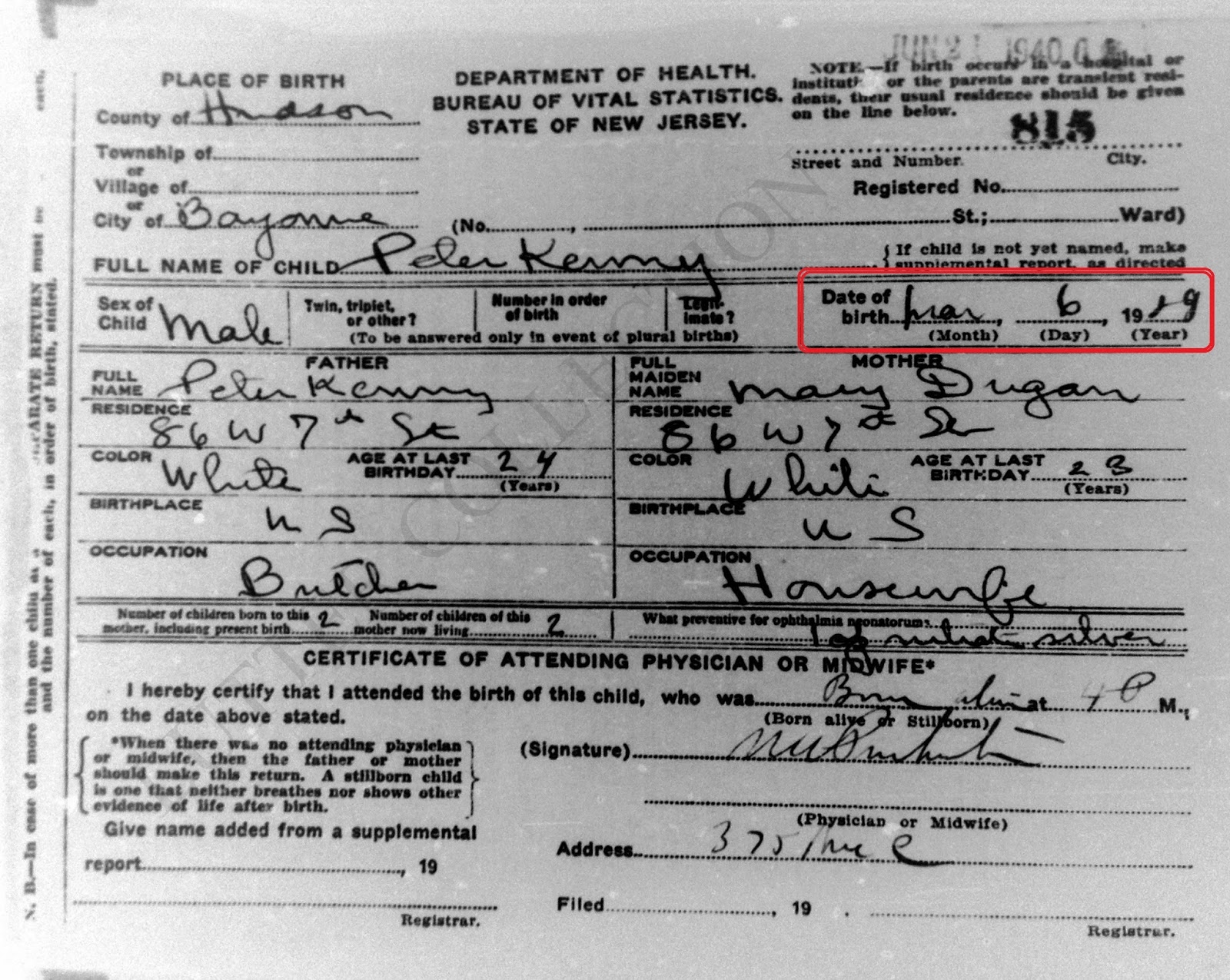
Birth certificate for Peter Kenny, born "March 6, 1919" in Bayonne, Hudson County, New Jersey.

The birth certificates for these siblings appear in order.  But wait- the dates were changed!  Changing the date is something I don't usually see and really makes you question the validity of any of these records.  Nevertheless, on the official form, under "Items to be corrected," "Date of birth" is one of the suggestions.

Correction to birth, 25 years later, during World War II.
The date of birth was changed by a month.
The place of birth was also changed from house number 36 to 86; but it is 86 in the original.

On the same date as his sister sought to amend her date of birth by a month,
Peter Kenny also amended his- by only three days.

When you encounter official corrections to a record, you will need to cite both the original and amended information and reference the respective sources.

These documents demonstrate that even a birth certificate is not absolute proof of the event.

Tuesday, January 21, 2014

License to Marry

People seeking to marry in New Jersey in the 1900s (through today) needed a marriage license first.  A license from this time period is not usually something that we get to see.  It is the certification of marriage or the marriage return that we find at the Archives or receive in the mail.  But I found a license, partially obscured, next to the certificate of marriage.  Note the bold ink stamps and the perforation on the left of the paper.

License to get married
Peter Kenny and Mary Dugan, issued November 2, 1916 in Bayonne, Hudson County, New Jersey

Certificate of marriage
Peter Kenny to Mary Dugan
November 15, 1916 in Bayonne, Hudson County, New Jersey
Copied at the New Jersey State Archives by J Lutter

Thirteen days later, the parties were married.  Above is the marriage certificate that we are used to finding.  Note the perforation on the right of the paper and the reverse ink stamps from the license on the back.

Maybe the two pages were separated before writing, but for this couple, the pages stuck together?  Lucky me that the back of the marriage certificate was also filmed so I can see the license as well.  This is also why you want to look at the images filmed before and after the object of your search has been located.


Friday, January 17, 2014

Church Records

I don't write much about church records, so here is a post about my use of church records- specifically Catholic church records.

A lot of my Irish Catholic lines moved to Bayonne, Hudson County, New Jersey in the 1800s.  The church records have been microfilmed and can be ordered through your local Family History Center.  I didn't get to it yet.  I figure I'll need a long sabbatical from my day job to chase all those Irish lines.  I was also hoping that the film would appear as images online so I could view them without leaving home.  In the meantime, you can access some of the information at home through the online New Jersey collection: Births and Christenings, 1660-1980, which is transcribed versions of some of the information you would find if you viewed the actual church record.

I was looking for information on an Irish line and found that the online collection of the Hudson County Genealogical and Historical Society has greatly expanded.  Brian Patrick Molloy has transcribed some of the records for the parish of St. Mary, Star of the Sea, in Bayonne.

I browsed all of the transcribed records and was delighted to see the baptismal entry for my great grandfather, Francis "Frank" O'Donnell.  I already have Frank's 1888 state-issued birth certificate, as well as his 1911 marriage return to Anna Preston.  Anna died in 1921.  I was told that Frank may have remarried.  There are a few ways of looking for a remarriage, but a (transcribed) church record is how I found this remarriage.

Look at the entry for Francis O'Donnell in the New Jersey Collection at FamilySearch.org.


Another researcher has helped me tremendously with German lines by sending me copies of actual church records.  Look at the example below of the information that you can find in the record of baptism.

The baptismal record can contain date of birth, date of baptism, names of parents, addresses.  But wait- there is more!  The sponsors are listed and they are usually related to at least one of the parties.  But that is not all!  The baptismal record can be updated with matrimony records!  Yes- you may find out the name of the spouse and the date of marriage.

As I mentioned, I did not look at the actual church record for Frank O'Donnell.  I viewed the online transcription.

The sponsors are listed!  Rose Kenny was a sister of Patrick O'Donnell and paternal aunt of Frank, the baby being baptized.  The first marriage to Anna Preston is listed, which I had already.  As a bonus, I get a lead on the possible second marriage.  "Sp?" indicated that the transcribed spelling may not be accurate, but that's okay- this is a transcription designed to lead to a closer record.  1940 is the final year of marriage records available at the New Jersey State Archives for me to walk in and copy.  Looking under the Letter O for the groom, which is how New Jersey organized marriage records in this time period, I found the marriage record for Frank O'Donnell to Mary Gertrude Farnan, widow of James Paradine.


Remember that indexes and transcriptions lead you to records and are not sources in their own right (unless there is a remarkable discrepancy, but that's for another post).


Wednesday, January 15, 2014

The Worthwhile Autosomal DNA Segment Analyzer


I have been using DNA testing as an adjunct to my genealogy research for a few years.  I use an Excel spreadsheet of my own design to keep track of the matches, which includes which DNA cousin matches my close family members and where.  It is time-consuming to manually enter each piece of information and then organize it by chromosome for each family member and note who else matches the DNA relative.

The purpose of organizing the DNA matches is to look for patterns to identify the Most Recent Common Ancestor- the source of the segment of DNA shared by living descendants.

I was delighted to read about DNAGedCom's new tool, the Autosomal DNA Segment Analyzer (thank you Roberta), developed by Don Worth.  (In order to use DNAGedCom you have to test your DNA first.  DNAGedCom is not a testing company.)  For this particular tool, data from FamilyTreeDNA is used.  I previously uploaded results for family members from 23andMe to FamilyTreeDNA.


Above is the table produced for chromosome 13 of my father's DNA test.  The match with the longest shared segment is me, naturally, represented by a black bar the entire length of the chromosome.  We will look at a third cousin whose DNA has been tested.  He and my father share a segment that is about half the length of chromosome 13, which is a lime green line in the above table.  This segment is from one of their shared ancestors, Calvin Cook or Mary Neil, who were the great great grandparents of my father on his mother's side.  Four more people also match this third cousin on this segment, indicated by the lime green box in their ICW column (in common with).  These means that I can collaborate with these four people, compare family trees, and find a link in all four to either Calvin Cook or Mary Neil.

Next view the two people who also match my father in the same area shared by the third cousin.  The are medium blue and maroon bars in the table.  These people do not match the third cousin.  I do not match the third cousin, but I do match these two people.  This indicates that these two people are related on my father's father's side of the family tree and at least the last half of my chromosome 13 came from my paternal grandfather.  From that point backwards, we cannot tell with this information if the matches are from my paternal grandfather's father or from his mother.

The tables for each chromosome show you how your genetic matches cluster together into theoretical branches of your tree.  You need to compare documented family lines to figure out the ancestors.


I would like to point out important features.  These tables were created using information from FamilyTreeDNA.  The names and email addresses of most matches are visible to their other matches (I blocked them here for privacy).  Selecting a match's name pops up a window with additional information, such as surnames and locations, that the match has typed into his/her profile.  This is in stark contrast to matches at 23andMe, most of whom are anonymous and do not respond to requests for contact or genealogical information.

23andMe DNA Relatives/Relative Finder
Anonymous matches with little to no profile information who do not accept contact.

Tuesday, January 14, 2014

Duryee Bible sold on Ebay

Last year, I wrote about a bible for sale on Ebay with a hefty pricetag of $1200.  The bible contained handwritten notes of dates and names for the Duryee/Mumford family.  The bible was relisted and today sold for only $152.  The lure of the bible was not only the family history information, but the age of the book.

If the purchaser would care to share copies of the family information contained in the bible, we would be most appreciative.

Ebay.com completed auction listing for Duryee family bible
Tip:  when searching for family treasures, try misspellings of "genealogy."

Picture of some of the family information contained in the bible.

Monday, December 30, 2013

Wednesday, December 25, 2013

Tail: Imlay and welcome Taylor

When I can't find discover someone's parents in my family tree, I call this a "tail."  Someone gave me this term to use instead of "brick wall."

A DNA connection turned up at 23andMe with Imlay of Monmouth County, New Jersey in his family.  I needed more on my Imlay line because mine stopped in the 1800s.  I need to travel back into the 1700s to make the DNA connection.

Ellen (or Eleanor) Euphamy Imlay was the Imlay tail.  She was one of my 4X great grandmothers.  She was married to William Walling (1804-1870) and lived her life in Monmouth County, New Jersey.  She died in 1895 in Keyport/Raritan Township in Monmouth County at age 87.  Her parents were listed as Elisha Imlay and Ellen Imlay.


Through the Red Bank Register newspaper archives (available free) I found a brother of Ellen, Joseph Imlay.


Joseph Imlay's death certificate listed his parents as John E Imlay and Eleanor Imlay.  Pretty close to Ellen's parents:  Elisha and Ellen.


FamilySearch has many (free) New Jersey resources, such as marriages recorded at the county level.  There is a marriage in Monmouth County for Elisha Imlay to Eleanor Taylor, 25 April 1802.  They fit as parents of Ellen and Joseph Imlay.


Imlay is a popular name in Monmouth County and is going to require quite a bit of sorting.  For the moment, I was luckier with Taylor.  The Monmouth County USGenWeb featured a transcription of a book, "Historical and Genealogical Miscellany," by John Stillwell.  There was quite a bit on Taylors of Monmouth County.

Of special interest was a blurb about two wills:
---George Taylor Senior, probated in 1835, mentioning that the children of his daughter, Eleanor Embly, would receive her share.
---James G. Taylor, probated in 1836, mentioning Joseph Imlay, son of Eleanor- James' sister.

Although this transcription of a transcription seemed to have the information to help me trace back two more Taylor generations, I could not rely on it as a source.  I could use it to get closer to the original source- the wills.  Again, FamilySearch makes available (for free) New Jersey surrogate records (except Morris County).  The wills (actually first transcriptions of the wills) and related court documents contain far more information and names than the book summaries, which is another reason to always get as close to the original record as possible.

Will of George Taylor Senior, written and probated in 1835 in Monmouth County, New Jersey
FamilySearch.org
George Taylor named a daughter, Eleanor Embly, in his will, but left her share of his estate to her children, who are not named.  Embly could be Imlay, but I need more to make a firmer connection.  This pattern of inheritance suggests that Eleanor Embly/Imlay was dead at the time the will was written.  Fortunately for research purposes 180 years later, George Taylor had many more children and he named them in his will.  This makes James G Taylor, whose will was probated one year later, likely to be a son of George Taylor.


James G. Taylor, will probated in 1836 in Monmouth County, New Jersey
FamilySearch.org

The will of James G. Taylor was probated in Monmouth County in 1836, one year after George Taylor Senior's will.  James' siblings are the children of George Taylor in the previous will.  Eleanor Embly became Elenor Imley, which is closer to Imlay.  But more importantly, her children were named, and they match what I already traced, that Eleanor's son was Joseph Imlay and her daughter was Eleanor Euphamy, who married William Walling.

So I now have parents for Eleanor Euphamy Imlay:  John Elisha Imlay and Eleanor Taylor.  TAYLOR is a new ancestral surname for me!

And I have to get back to John Elisha Imlay, for he is my new Imlay tail.

1.  George Taylor (d 1835)
     2.  James G Taylor (d 1836)
     2.  Eleanor Taylor (d before 1835) married (1802) John Elisha Imlay
           3.  Eleanor Euphamy Imlay (d 1895) married William Walling
           3.  Joseph Imlay (d 1894) married Martha Roberts


Friday, December 20, 2013

Preserved in a photograph

A wonderful photograph has come into my possession through eBay.  To be specific, it is an old type of photograph, a carte de visite ("CDV") from the 1860s.  It is small, four inches by 2/12 inches.  The image is a head shot of a man with a receding hairline, beard, dressed in a suit.

The auction advertised this carte de visite as:  "Civil War Era CDV Photo Garrett S Duryea Cold Springs Harbor LI NY."


On the back of the photo was written in pencil:  Garrett S. Duryea.  I have a few men with this name in my close family tree, as well as extended branches.  I needed to identify which Garrett could be portrayed in the photo.


First I looked up the photographer to get an idea of when this CDV may have been made.  One of the ways of dating a photograph is by finding out when the photographer was in business.  The imprint is on the back:  Banta, photographer, Hopper, photographer, No. 225 Bleecker street, N. Y.  At the website Langdon Road, Banta operated out of Hopper on Bleecker street in New York City in the 1860s.

So we are looking for a Garrett Duryea who was above the age of 30 in the 1860s in the New York City area, and there are a few candidates.  But- the eBay listing gave a location of Cold Springs Harbor, Long Island.  I googled "Garrett S. Duryea."  The first few listings were the site Long Island Surnames.  The featured Garrett S. Duryea was married in 1856 in Cold Spring Harbor and could be about the right age to be the subject of this CDV.  But I think that there is a better choice for the subject- a Garrett more closely related to me.

My 3X great grandfather, Stephen C. Duryea, had a brother named Garrett S. Duryea.  Garrett was younger than Stephen and probably born around 1820 in New York City.  I have not found any marriages or children for Garrett.  I found him in the census and city directories living with extended family.  He worked on ships, so it is possible that he may have been away from New York City for extended periods and missing from records during those times.

In the 1860 census, Garrett Duryea was living in New York City in what appears to be some kind of rooming house.  His cousin, Parmenas Jackson, is also a resident, which helps distinguish this Garrett S Duryea from the others.


Garrett's next chronological record is the 1866-67 city directory.  He was residing at 540 Greenwich in New York City.  This address housed different family members over the years, so that is how I know that this is the same Garrett S. Duryea.


Garrett's residence, 540 Greenwich, is about half a mile from Hopper's studio, 225 Bleecker.  Cold Spring Harbor on Long Island (Suffolk County) is about 35 miles away.

Mapquest.com

If the photograph is correctly labeled as Garrett S. Duryea, then this is likely my 3X great granduncle.  That is another, important variable:  we do not know who wrote the name on the picture and with what knowledge, so this may not be one of the men named Garrett S Duryea at all.  I have no photographs for any of his siblings or their children, so I have nothing to compare his image to see family similarities.  If I acquire photos of his generation or the next, I may be able to more firmly say that this is likely Garrett.


Thursday, December 19, 2013

Double enumeration in the census, part four: New York City 1870

Your biggest and most obvious hint to check for a double enumeration in the census is when the census was repeated.  This happened in New York City for the 1870 census.

I found a family listed twice in New York City in 1870, but not in the first and second enumeration.  They appeared in the second enumeration as well as their new homes outside of New York City.


This is a household located on Spring Street in New York City, 1870.  First listed is Stephen Duryea, his wife Mary, and some of their children.  Living in this household is also Abraham Brewer (uncle of Mary), Anna [Frances Duryea], Abraham Brewer [nephew of Abraham Brewer], and Anna Flynn.

Both groups are in New York City in 1860, but not in 1880.  1870 seems to be the time this family moved out of New York City, though not together.  Stephen moved to Westchester County.

I typed out the words for easier reading.


Abraham moved to Rockland County and founded the Brewer Engine Fire Company in Monsey.


Wednesday, December 18, 2013

Double enumeration in the census, part three

Michael Preston has a double enumeration in the 1900 United States census.

How did I find both?  I stumbled across these two records by looking for the census entries for all of his children- not just the one from whom I descend.

He is listed with his wife, Catherine [Donnell], two daughters, and four grandchildren in Hackettstown, Warren County, New Jersey.

Preston, Michael.  Preston, Catharine.  Preston, Hannah.  Preston, Catharine.
Ultcht, John.  Ultcht, Catharine.  [Children of Charles P Ultcht and Anna Preston]
Walsh, Joseph.  Walsh, John.  [Children of Jeremiah Welch and Mary Preston]

He is also listed in the household of his son, John, in neighboring Independence.


Michael is married in one listing and widowed in the other.  This value in this double enumeration is that we can hone in on a death date and location for Michael's wife, Catherine Donnell.  In 1899 or 1900, the family relocated from Dutchess County, New York to Warren County, New Jersey.  Catherine was alive in the 1880 census; finding her husband listed as widowed and married in 1900 in New Jersey should narrow down the search for her death record to one year and one state instead of twenty years and two states.  I have, however, been unable to find a record of Catherine's death in either state.

Michael again moved shortly after the 1900 census.  He died in Bayonne, Hudson County, New Jersey in 1904.