Wednesday, March 2, 2016

Matrilineal DNA, Destination Ireland

In December I tested my mitochondrial DNA ("mtDNA") with FamilyTreeDNA.  My first mtDNA test was over five years ago with Ancestry.com and is now essentially defunct.

My mtDNA haplogroup is H1au1b, which is not very common.


Well, I have four matches to work with.

This DNA test looks at a specific kind of DNA in the mitochondria of cells.  Unlike autosomal DNA in the nucleus of a cell, mitochondrial DNA does not change from generation to generation.  A person's mitochondrial DNA is an exact copy (minus some mutations) of that person's mother's mitochondrial DNA.  The mitochondria are nicknamed the "powerhouses" of cells.  Their DNA is portrayed as circular like bacterial DNA, not a double helix like nuclear autosomal DNA. 


My direct maternal line is not long on paper.  I can trace back to my great great grandmother, Bridget Sheehy.  She was born in Ireland about1857.  She married John Preston (1857-1928) around 1877 in Dutchess County, New York.  The mitochondria in my cells are identical to the mitochondria that powered Bridget's cells.


Bridget Sheehy (1857-1916), wife of John Preston
Courtesy of Irene Preston

Bridget died almost one hundred years ago on 5 April 1916 in Bayonne, Hudson County, New Jersey and is buried at Holy Name Cemetery in Jersey City.  Her death certificate listed the names of both of her parents, Edmond [or Edward?] Sheehy and Bridget Frawley.


There was a couple by this name living in Dutchess County, Edmond Sheehy (1825-1893) and Bridget Frawley (1826-1905).  Bridget's death certificate lists her parents as John Frawley and Mary Shea of Ireland.  I lucked out again.  The death certificate for every ancestor on my direct maternal line includes the full names of both parents up through this possible fourth great grandmother.


A wonderful clue was in a newspaper article from 1936 in The Harlem Valley Times from Amenia, Dutchess County.  [Free access through FultonHistory.com.]  The article detailed the 50th wedding anniversary of a couple, Thomas Culligan (1863-1937) and Ellen Sheehy (1866-1938).  Ellen's parents were "Edward" Sheehy and Bridget Frawley of Limerick, Ireland.

Was Ellen a sister of my Bridget?


I want to assign my Bridget Sheehy to this family from Amenia.  But there is no connection in any of the documents I found so far.  In the anniversary article above, no relatives named Preston or from Bayonne are mentioned.  The only child mentioned in the 1905 obituary of Bridget Frawley Sheehy, possible mother of my Bridget, is her daughter from the newspaper article, Ellen Sheehy Culligan.


My Bridget's first definite appearance is in the 1880 federal census in Stanford, Dutchess County, when she is already married to John D Preston and has children.  But in the 1875 New York state census is a Bridget Shehea, age 22, born in Ireland, a servant to the Bertine family in Amenia.  The next family is James Shea of Ireland, his wife, Catherine [Ahearn], and their children, Thomas, Nora, Catherine, and Margaret.


The seven year old Thomas Shea in the 1875 census is Thomas James Shehea (1867-1885) at FindAGrave and linked to parents James T Sheely (1828-1902) and Catherine Ahern (1838-1925).  This tells me that the surname underwent spelling modifications.  This family, as well as the Sheehy and Culligan families, are buried at Immaculate Conception Cemetery in Amenia, Dutchess County, New York.  Is my Bridget related to James Shehea/Sheely/Sheehy?


Consider the 1892 New York State Census.  "Edward" Sheehy and Bridget Sheehy are enumerated in Amenia.  The prior family is Mary Ahearn, age 40; she is a daughter of Edmond/Edward Sheehy and Bridget.  At the bottom of the page is a Sheehy family, unfortunately cut-off.  The male head of household is 64 years old, just one year shy of Edward Sheehy.  Could this be James Sheely/Sheehy and his wife, Catherine Ahearn?  The eleven year old child is also unviewable, but the next page has Nellie Sheehy, age 14.  Nellie was a daughter of James Sheehy and Catherine.

Were Edmond/Edward Sheehy and James Shehea/Sheely/Sheehy brothers?  Or is James a relative of Mary Shea, the possible maternal grandmother of Bridget?  Or were the names of Bridget's parents wrong on the death certificate?

To utilize my mtDNA test, if Ellen Sheehy, wife of Thomas Culligan, was a sister of my Bridget, and we could possibly find a living direct maternal line descendant of Ellen, that person's mtDNA would be identical to mine.  Ellen had one daughter, Florence (1898-1979), who had children with John McEnroe (1923-2005).  If any of those children are still alive, they could test; otherwise, the eligible candidates would be children of Florence's daughter, Eileen McEnroe (1932-2011), wife of Guenther Hans Strauss (1927-1999).

Saturday, February 6, 2016

Family Tree Repair: O'Donnell

More markers were tested for an O'Donnell cousin's Y-DNA test at FamilyTreeDNA.  We originally started with only 37 markers, but the results were too numerous to work with.  Now 111 markers are tested.

(Y-DNA is passed almost identically from father to son through the generations.  A match on the Y chromosome means that somewhere back in time, two men share an ancestor on their direct paternal lines.  The fewer the differences between their Y chromosomes, the more recent the common ancestor.)

At this point, there are over 800 matches at 37 markers, but over 1400 matches at the higher level of 67 markers.  Jumping to 111 markers eliminates all but three genetic cousins.  If someone did not test at the 67 or 111 marker level, then they would not appear in those subsets.  A lot of the 67 marker matches are viable.  They just have not tested more markers.


The top match at the 111 marker level is the same O'Donnell cousin of my initial focus.


This O'Donnell line came to Boston, Massachusetts from Ireland.  When I originally encountered this line, the most distant ancestor was listed as Philip O'Donnell.  After some research into two men both with this name living in Boston in the 1800s, Cornelius O'Donnell (1828 - 1899) seemed like a better match for the tail in this tree.  Cornelius' death record listed his parents as James O'Donnell and Mary Kerr of Ireland.


Adjustments have been made in my O'Donnell line as well.  To research in Ireland, you need an exact location.  I had a hometown courtesy of a more prominent branch containing Father Charles Leo O'Donnell (1884 - 1934).  The obituary of Patrick O'Donnell (1856 - 1931), my great great grandfather, stated that Father Charles, president of Notre Dame University, was his nephew.


Online trees and articles provide the parents of Father Charles as Cornelius "Neil" O'Donnell (1837 - 1909) and Mary Gallagher (1852 - 1924).  I thought that Neil O'Donnell was a brother of Patrick O'Donnell, my great great grandfather, and so my line was from Ardara as per the poem.  But- keep in mind that none of this online information is a primary or even secondary source.


I noted that Mary Gallagher had the same surname as her husband's mother (working with the idea that his parents were Patrick's parents), but both names are plentiful in Donegal and not indicative of recent familial ties.

Then greetings came from Ireland.  (Thanks EO!)  A cousin of Father Charles wrote to me.  Neil O'Donnell was not the brother of Patrick O'Donnell, but rather a brother-in-law.  Mary was not named Gallagher; she was an O'Donnell herself.  So my O'Donnells were from Killybegs (see the poem), not Ardara.  Patrick and Mary were siblings; their parents were Peter O'Donnell and Margaret Gallagher.

I had no marriage record for Neil O'Donnell and Mary "Gallagher."  Their first child, Rose, was born in Indiana around 1870.  The Indiana marriage index (online at Ancestry.com) has an entry for Neil O'Donnell and Mary O'Donnell, married 4 November 1869 in Hancock County.  I ordered the certificate by mail to try to confirm if this is the right couple.  They may have met "on the road, in Donegal," but they married in Indiana.


Friday, January 15, 2016

Second Y-DNA Match for Duryea

Another bonafide Y-DNA match appeared in my Duryea cousin's matches at FamilyTreeDNA.  (You can read about the first match here.)  To find the ancestor in common for someone who shares an identical Y chromosome, we trace the direct paternal line.

At FamilyTreeDNA, the Y chromosome can be tested on 12 to 111 markers.  This new cousin tested at the 25 marker level.  When compared to my close Duryea cousin, only one marker out of 25 is different.  When compared to the first Y-DNA cousin, the match is 25 out of 25.  The variation on one marker possibly arose in my line.


This new cousin traces his Duryea line back to the immigrant Joost Duryea, as do the first Y-DNA cousin and I.  But we do not have to go back to Joost in the 1600s for the most recent common ancestor.  This newest cousin is related more closely.  He is my sixth cousin.  He is a fourth cousin, twice removed of the person who donated the DNA for my Duryea line.  He is descended from Joshua Duryea, a brother of Garrett Duryea (1777-1834), the former stray and link of my family to the larger Duryea family.


This DNA link does not prove that Garrett and Joshua were brothers, only that we share a common ancestor along our Duryea lines.  But it is great that the match is someone whose paper trail splits at the point previously in question for my line.


Thursday, January 14, 2016

Family Tree Repair: Duryea

Before we explore the next Duryea Y-DNA match (you can read about the first one here), I need to clarify my branch of the Duryea family.  This is important because it took years to figure out and erroneous online family trees persist.

My Duryea branch traces its direct paternal lineage back to Stephen C Duryea (1814-1887) of New York City and Pound Ridge, New York.  Stephen's father was Garrett S Duryea and his mother was Ann Cornell.  The trick was fitting Stephen's father, Garrett, into the larger Duryea family.

The theory (thanks to RAM) was that Garrett S Duryea, the father of my line, was the youngest son of Jacob Derye (died 1781) and Sarah Smith of Jericho, Queens County, New York.  [His will is transcribed here.]


No other researchers had published what became of this Garrett.


The clue that linked my Duryea branch to the larger Duryea family occurred because the State of New York did not pay John Frazee (1790-1852), architect, for his work on the Custom House.  [His papers, including family tree diagrams, are digitized online.]  John Frazee's widow, Lydia Place, sued to recover wages due to her late husband.  My ancestor, Stephen C Duryea, testified on her behalf.  He stated that he was "distantly related to the petitioner; the claimant's father and my father were half brothers."


This testimony meant that my stray Garrett Duryea had a half brother.  Further research showed that Sarah Smith, widow of Jacob Derye, remarried to James Place in 1783 and had a son, Thomas Place.  Thomas Place had a daughter, Lydia, around 1815, and she married John Frazee.  See the diagram below for a picture representation of this.


Once this connection was established, additional interactions between PLACE and DURYEA became more apparent.

Garrett Duryea, the son of Jacob Derye and Sarah Smith, died in Jamaica, Queens County, New York, on 29 March 1834.  Settlement of his estate was disrupted two years later by the death of his son, John Horton Duryea, administrator.


This is not the same Garrett Duryea who died in Blooming Grove, Orange County, New York, contrary to what most online family trees assert.


Wednesday, January 13, 2016

Cousin from the Dunn and Dunlop Branch

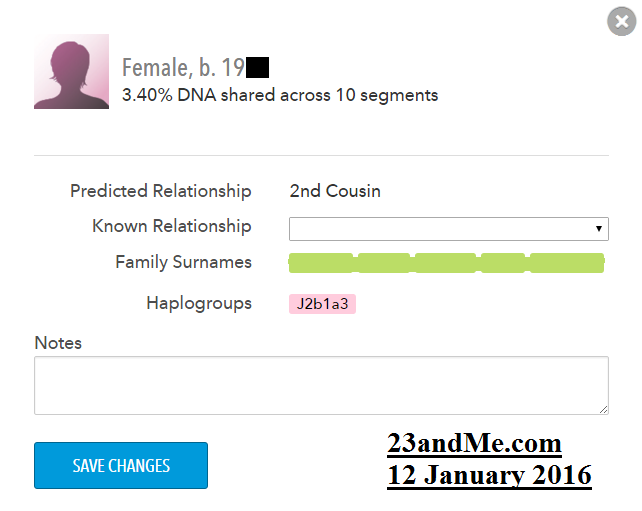
A close cousin on my father's side appeared among the DNA matches at 23andMe.  This person also matches all three of his siblings, as well as their father's first cousin.


We do not have to look at my father's entire family tree for the connection to the DNA cousin.  We can concentrate on the branch that my father has in common with his father's first cousin.  I made a diagram and I hope this helps people understand how to do this with their own DNA matches.


As you may have read, the 23andMe site is morphing.  I manage several accounts and none of them have completely evolved.  What I see on my end are new matches, but I cannot contact them.  The ones with names lead to a "page not found," while the anonymous matches cannot be contacted.  This new close cousin is anonymous, but she left her year of birth and some family surnames that I can see.


Based on the surnames she provided, we may be fourth cousins.  I predict that we share a set of great great great grandparents, Ezra Dunn (1821-1898) and Hermoine Dunlop (1827-1900) from Matawan, Monmouth County, New Jersey.  I descend from Ezra and Hermoine's daughter, Katherine (1865-1944), while this mystery cousin descends from another daughter, Violet (1873-1931).  Dunn and Dunlop were not among the surnames she provided, though, so either I have the wrong cousin, or our common ancestors are behind a brick wall for her, or she did not list all the surnames she knows.

The point of continuing on this DNA journey with this close cousin is to utilize the identical segments of DNA.  She shares ten identical segments with my grandfather's cousin!  (23andMe used to require that people "share genomes" to see these identical segments.  I have no such option with new matches- I can't contact them.)  We can attribute those ten segments of DNA to our ancestors, Ezra Dunn and Hermoine Dunlop.  More distant cousins will also match on these same segments, usually in smaller pieces.  Just as I did in the above family tree diagram, we can look deeper into the trees of Dunn and Dunlop and work with the distant cousins to figure out their relation to my family.


Tuesday, January 12, 2016

Genealogy Brick Wall Crumbled

Brick wall down!  The parents of Mary Neil, my 3rd great grandmother, have been discovered.

Five generations of my father's family tree.
The focus of this discussion is Mary Neil (1830-1898), a great great grandmother of my father.

Mary Neil married Calvin Cook in 1847.  Like most of the marriages recorded in Morris County, New Jersey in this time period, the names of parents were not included.

New Jersey County Marriage collection at FamilySearch.org.  Free index and free images.

In other records, Mary was born in New Jersey around the year 1830.  As time went on, some of her children recorded her name as O'Neill on their documents and gave her birthplace as Ireland.

In the 1870s, the family relocated to Jersey City in Hudson County.  Calvin died in Jersey City in 1889.  I found his death certificate with no difficulty in the Archives in Trenton; however, I could not locate his final resting place "at Dover" until someone kindly posted on FindAGrave the stone for Calvin and Mary's son, William Cook, who died in 1871.  The family plot is located at Locust Hill Cemetery in Dover, Morris County.  This was discovered over two years ago.

Mary's final passage is recorded on the same stone as her husband, Calvin.  She died August 9, 1898.


Great!  I had Mary's date of death.  But I still could not find a death certificate or obituary for her.

Time passed.  Recently I was at the Morristown and Morris Township Library and checked the Morris County newspapers again.  The few papers for the area for 1898 were published weekly, so I did not have too much to sift through.  This time, an obituary in the paper "The Iron Era" from Dover caught my attention.  Mary A Keating died on August 9, 1898 and was buried at Locust Hill Cemetery-- just like my Mary.  She was the wife of Nicholas Keating and lived in Rockaway.  No other family members were mentioned.

Could Mary Keating be Mary Neil, widow of Calvin Cook?

Digitized newspaper collection at the Morristown and Morris Township Library.  Free on-site usage.
At home, I checked the online index of New Jersey marriages at FamilySearch.  Calvin Cook died in 1889, so if Mary remarried, the date would be in the 1890s.  And there it was.  Mary remarried in 1892 (this is the correct year) in Jersey City to Nicholas Keating.

FamilySearch.org.  New Jersey Marriages.
This is a free index.  The images are not online.  They are at the Archives in Trenton.

This marriage record was my best chance of finding out the names of Mary Neil's parents, as the record was created during Mary's life.

I looked through the index at FamilySearch for Mary's death certificate, but found no matching entry.  Both Mary and Nicholas died in 1898 and their estates were probated through the Surrogate's Office of Morris County.

MorrisSurrogate.com
This is a free service to search probated estates in Morris County, New Jersey.
The actual files are in the court house.  [The other twenty New Jersey counties are online at FamilySearch.org.]


At the Archives in Trenton, I found Mary's marriage record to Nicholas Keating.  Her parents were listed as Charles O'Neill and Catharine Brougham, both of Ireland.  (This explains the source of the names for two of Mary's children.)


Witnesses were Margaret Tower, Mary's daughter; and Harry Tower, Mary's son-in-law.

I found a death certificate for Mary Keating.  No day of death is on the certificate; only the month and year- August 1898.  Maybe this is why it missed the index?  I looked at the microfilm roll of deaths from 1 July 1898 through 30 June 1899, Morris County, surname K.  This same method did not produce a death certificate for Nicholas Keating, who died 21 December 1898 according to his estate papers.


Whoever provided the information for Mary's death certificate only knew that her mother was "Katie."  This is why it is best to try to obtain a record created during the person's life.  (Cause of death was "cerebral haemorrage," probably a stroke.)


I went through the census to find Nicholas Keating.  In the 1860 federal census in Rockaway, Nicholas and his first wife, Catherine Shaw (1825-1891), were living next door to Mary Neil and her first husband, Calvin Cook.  32 years later, both of their spouses would be dead and Nicholas and Mary would marry each other.  For the record, Catherine Shaw was not merely a neighbor.  She was a first cousin of Calvin's father; the common ancestors were Conrad Hopler (1730-1815) and Elizabeth DeMouth (1735-1812).


In the 1895 New Jersey state census, Mary and Nicholas were residing together in Rockaway.  Had I not made the connection with the obituary, this piece of the puzzle could have provided a big clue.  I do not know how the three people named Nix tie into this yet, but look at the last person in the household, a child, Francis A Peck.  He is a grandson of Mary.  His parents were Calvin Peck (1848-1923) and Catherine Cook (1854-1885).  Francis was born on the 28th of April in 1885 in Jersey City.  Three weeks later, on the 17th of May, his mother, Catherine, died.


Mary's estate papers clearly list her surviving children and her grandson.  But estates are organized by the surname of the deceased, not by those who inherit.

Mary also left money to Louisa Lee "of Dover, N[ew] J[ersey], niece of my deceased husband Calvin Cook."  I don't know why Louisa received this special treatment.  Louisa's mother was Anna Cook, a sister of Calvin; her father was Jesse Lee.

Next I need to research Charles O'Neill and Catharine Brougham.  I'm not convinced that they were Irish.

Wednesday, January 6, 2016

Handmade Death Certificate

William Martin Kent, died 14 September 1891 in Lake Hopatcong, Morris County, New Jersey.
Accidental drowning.

I found this death certificate from 1891, notable because it is written on a piece of paper instead of the state-issued form.

New Jersey death certificates for this time period look like the certificate below.


Catharine Keating, died 10 October 1891 in Rockaway, Morris County, New Jersey.
Father: James Shaw.  Mother: Margaret [Hopler].

Thursday, December 10, 2015

Twelve Years at FindAGrave


Twelve year anniversary at FindAGrave.

I added almost 600 memorials since last year.  The mobile app enables fast and easy creations of memorials and additions of pictures.

This website is a free resource crucial to your genealogy hunt.

Saturday, November 28, 2015

Online Index to New Jersey Vital Records 1901-1903 Coming Soon

New Jersey indexes of vital records from the early 1900s will be coming online.

This is great news from a group called Reclaim the Records.

The covered years and types of records:
---Birth Index 1901, 1902, and 1903
---Marriage Index, Grooms, 1901, 1902, 1903
---Marriage Index, Brides, 1901-1914
---Death Index 1901, 1902, and 1903

According to their announcement, Reclaim the Records purchased copies of the microfilm rolls from the New Jersey State Archives.  The images will be digitized soon and posted online for free at Internet Archive.

These are indexes and not the actual certificates of birth, marriage, and death.  You will still need to request a copy (for a fee) from the Archives or someone who does research on site.

Before a trip to the Archives, I use the online indexes so I can jump directly into the rolls of certificates.  Adding years 1901-1903 will be a great help.

Why these years?  Well, New Jersey has had funny ways of organizing their vital records over the centuries.  A proper discussion requires more than a paragraph, so for now, I'll just write that it can be confusing.  Below is an example from the Index of Births covering June 1, 1878 through June 30, 1890, just so you get an idea of what we're dealing with.

[You can search online indexes of events prior to 1901 online at Family Search, Ancestry, and the State Archives index (Google it- the URL keeps changing).  Remember that these online indexes are not records unto themselves.  The dates are wrong sometimes.]


Around 1900, New Jersey decided to organize its vital records using a different system: Year by year, from January 1 through December 31, in order of date received.  In 1904, the birth and death certificates are organized by year, then surname, eliminating the need for a yearly index.  To find a birth or death, you search the actual certificates for a surname year by year.  [1923 is the final year of births currently housed at the Archives.  The death certificates now reach to 1955, but the alphabetical organization gave way to dates starting in 1949.]

Marriages are different because there are two parties, usually with different surnames.  When marriage certificates became organized by surname ahead of date, the groom's surname was used; hence, an index of brides was needed.  This is why the Index of Brides extends into 1914 while the other indexes are only from 1901-1903.  [The Index of Brides at the Archives extends into 1938.]


1903 Index of Births, New Jersey

1901-1903 Index of Brides, New Jersey

1902 Index of Deaths, New Jersey

1903 Index of Deaths, New Jersey

1910-1914 Index of Brides, New Jersey