Growing family trees from leaves and branches. Finding lost relatives. Solving family mysteries. Concentrating in New Jersey and New York.
Pages
- Home
- Surnames and Locations of My GGG Grandparents
- DURYEA New Jersey Births
- DURYEA New Jersey Marriages
- DURYEA New Jersey Deaths
- DURYEA New York State Marriage Index
- DURYEA New York State Death Index 1881-1950
- Pictures by Clifford Lutter 1930s-1960s New Jersey
- ODonnell- New Jersey Records
- Hit or Miss Records
- Adoption Laws New Jersey
- Genealogy Humor
- Bayonne Neighbors
Friday, October 28, 2016
LivingDNA Test
I took another DNA test.
LivingDNA.com is a DNA testing company based in the United Kingdom. The analysis will include a breakdown of ancestry into eighty different regions of the world, 21 of them specific to the United Kingdom. I will share my findings with you.
My kit cost $159 (US Dollars) and shipped in three days from Kentucky, United States.
Cheek swabbing is the method of collection.
My mother's ancestry is of recent origin from Ireland. I am hoping that this DNA test may reveal geographical areas of prevalence in my DNA and link me to close cousins in the United Kingdom. If customers are primarily from the same country as my mother's ancestors, LivingDNA could be a deeper pool of potential close cousins than other companies whose customers are overwhelmingly from the United States.
I'm not a fan of ancestry results, finding them widely varied, and prefer to see DNA cousins to figure out the common ancestors.
Tuesday, October 4, 2016
Patrilineal DNA of Five Duryea Cousins
![]() |
New York
County, New York, Wills and Probate Records, 1658-1880 (New York State Archives) for Joost
Deriew (#787) at Ancestry.com. J0038-92:
Probated Wills, 1662-1827. Wills,
0621-0820, (1662-1761).
|
Duryea is one of the most researched names in my family tree. The patriarch Joost, whose surname was spelled in different ways, removed from Mannheim (Germany) and settled in New Utrecht, Kings County, New York, around 1675. Today thousands of people can trace their descent from Joost.
Although Joost is long gone, his Y chromosome survives in his direct male descendants, passed from father to son through the generations, identical unless a mutation occurred.
My grandmother's first cousin, Bruce, supplied his Duryea Y chromosome for testing at Family Tree DNA to further research into the Duryea family history. (Bruce passed away in 2015.)
In the database four other descendants of Joost are identified.
Below is family tree demonstrating the relationships of the five tested men among themselves and to their common ancestor, Joost.
Person 3 is Bruce (my first cousin, twice removed). He was in the ninth generation, making him nearest Joost. He tested 111 markers. Person 1 tested 37 markers. Persons 2, 4, and 5 tested 67 markers.
Persons 1 and 2 descend from Joost's son Joost. Bruce and Persons 4 and 5 descend from Joost's son Charles.
The 67 markers of Persons 4 and 5 are identical. They differ from Bruce by a genetic distance of two out of 67 markers and from Person 1 by a genetic distance of 1 out of 37 markers.
The outlier is Person 2. His closest relation, Person 1, also a descendant of Joost's son Joost, more closely matches the descendants of Joost's other son, Charles.
We could say that the patriarch Joost's Y chromosome was likely the marker values seen in Persons 4 and 5.
This is my first opportunity to compare Y-DNA among testers who are related by a paper trail. Any comments or suggestions are appreciated.
Thank you to Roberta Estes for her illustrations and explanations of Y-DNA and to Jim Owston for his case study.
Saturday, October 1, 2016
Duryea Cousin
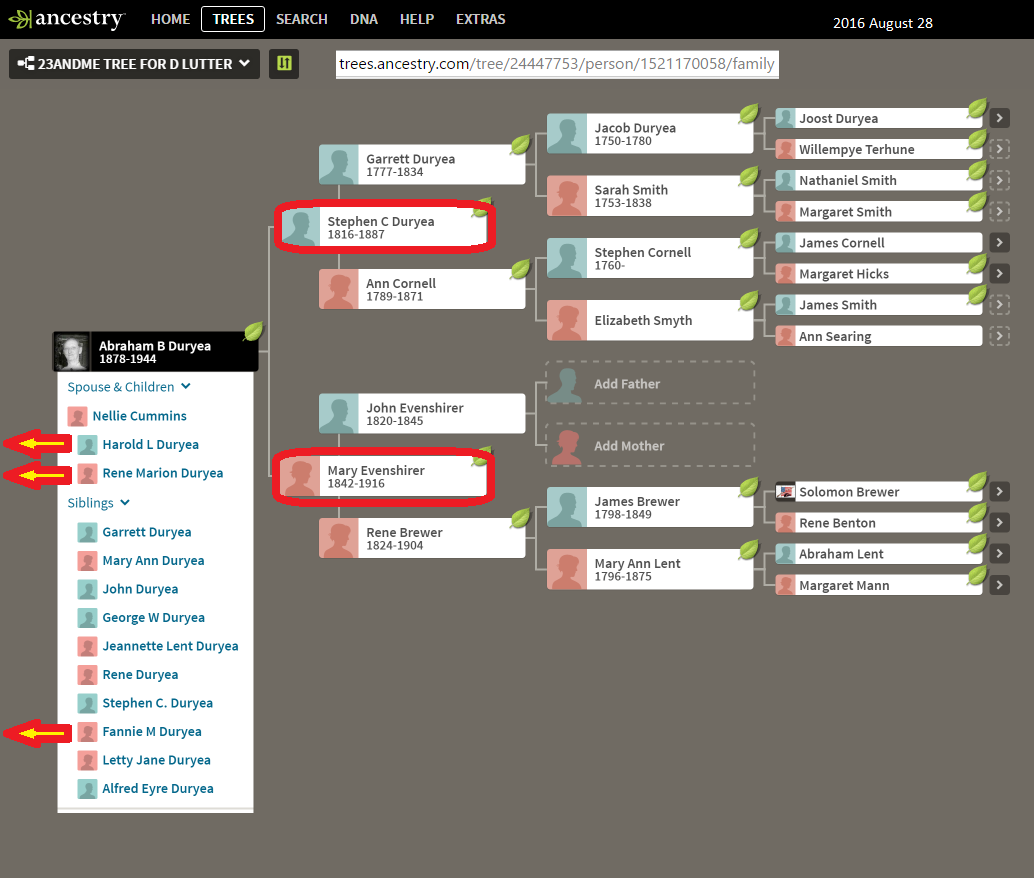
A Duryea cousin has been found through DNA testing! "C J" and I are fourth cousins. Our common ancestors were our third great grandparents, Stephen C Duryea (1814-1887) and Mary Evenshirer (1842-1916). I descend from their son, Abraham Brewer Duryea (1878-1944), who married Nellie Cummins (1879-1965). C J descends from their daughter, Fannie Duryea (1875-1943), who married Judson Cooke Drake (1877-1938).
This was as far as we can go with our DNA tests at Ancestry because Ancestry does not let us see where the shared DNA is. C J kindly uploaded Ancestry's DNA file to GedMatch so that we can utilize our DNA tests.
My father and his siblings are on GedMatch, as well as two cousins from the prior generation from this Duryea line. Below is the table showing the amount of shared DNA with this cousin cluster.
Notice that the person in orange (my aunt), shares only one segment above 7 cM with C J. A lot of people prefer to not work with small, single segment matches, as the most recent common ancestor could be very far back in time, or otherwise not discoverable. The shared DNA of the other matches demonstrates the variability in the amount of shared DNA and that this is a workable match.
Dropping the threshold of the size of the shared segment to 3 cM, a visual graph of the shared DNA on the chromosomes was created thanks to Kitty Cooper's Overlapping Segment Mapping Tool.
Some of the segments shared with C J were not previously attributed to Duryea/Evenshirer. As seen in the current family tree, the parentage of John Evenshirer remains a mystery. Some of his DNA may be represented in the shared segments with C J.
Everyone in my group matches C J on a segment on Chromosome 11. Three other people also match on this segment with a size of 15 - 30 cMs. We explored that the common ancestor was Abraham Riker, also known as Abraham Rycken Van Lent, who in 1654 built a house that still stands, with the family graveyard in the back, in what is now East Elmhurst, Queens County, New York.
The last Lent in my line was Mary Ann Lent (1796-1875), wife of James Brewer (1798-1849). Her parents were Abraham Lent (1772-1851) and Margaret Mann (1773-1844). Could a segment of DNA from the original Lent immigrant still be in descendants 350 years later? He was my 11th great grandfather.
This was as far as we can go with our DNA tests at Ancestry because Ancestry does not let us see where the shared DNA is. C J kindly uploaded Ancestry's DNA file to GedMatch so that we can utilize our DNA tests.
My father and his siblings are on GedMatch, as well as two cousins from the prior generation from this Duryea line. Below is the table showing the amount of shared DNA with this cousin cluster.
Notice that the person in orange (my aunt), shares only one segment above 7 cM with C J. A lot of people prefer to not work with small, single segment matches, as the most recent common ancestor could be very far back in time, or otherwise not discoverable. The shared DNA of the other matches demonstrates the variability in the amount of shared DNA and that this is a workable match.
Dropping the threshold of the size of the shared segment to 3 cM, a visual graph of the shared DNA on the chromosomes was created thanks to Kitty Cooper's Overlapping Segment Mapping Tool.
![]() |
| Note: Chromosome 11 is altered to reflect that all six cousins match C J here. The Mapping Tool accommodates only four. |
Some of the segments shared with C J were not previously attributed to Duryea/Evenshirer. As seen in the current family tree, the parentage of John Evenshirer remains a mystery. Some of his DNA may be represented in the shared segments with C J.
Everyone in my group matches C J on a segment on Chromosome 11. Three other people also match on this segment with a size of 15 - 30 cMs. We explored that the common ancestor was Abraham Riker, also known as Abraham Rycken Van Lent, who in 1654 built a house that still stands, with the family graveyard in the back, in what is now East Elmhurst, Queens County, New York.
The last Lent in my line was Mary Ann Lent (1796-1875), wife of James Brewer (1798-1849). Her parents were Abraham Lent (1772-1851) and Margaret Mann (1773-1844). Could a segment of DNA from the original Lent immigrant still be in descendants 350 years later? He was my 11th great grandfather.
![]() |
| Last census for Abraham Lent. He died in 1851. He was neighbors with the author, Washington Irving. They are also buried near each other in Sleepy Hollow Cemetery. |
Friday, September 23, 2016
23andMe Price Reversion
The DNA genealogy testing company, 23andMe, has lowered its price back to $99 (US dollars) after doubling it to $199 one year ago. This fee is for the genealogy portion of the site only. To receive "health reports" and information on your traits, you need to pay the full $199. You can opt out of the genealogy section at any time (or stay in and then complain that DNA cousins contact you).
For $99, you are matched with other testers who share pieces of DNA with you, indicating that you share a common ancestor back in time. You also receive an estimate of your inherited ancestry.
This price reversion is a step in the right direction. The site recently overhauled its layout and offerings and I am displeased and frustrated by the new format.
This same DNA genealogy test (autosomal) is currently priced $79 at FamilyTreeDNA and $99 at Ancestry.
You may have seen 23andMe kits sold in drugstores for a low price of $30. This does not include the lab fee of $169, which brings the price to $199. Be aware that this is the same price as ordering online. This is convenient if you unexpectedly meet up with a relative whose DNA you need to collect immediately.
For $5 (US) you can upload the DNA file from any of these three companies to Promethease for health and trait information.
For free you can upload to GedMatch for enhanced ancestry calculations. You will also be matched to DNA cousins from the other companies as well as WeGene, a Chinese DNA testing company.
For $99, you are matched with other testers who share pieces of DNA with you, indicating that you share a common ancestor back in time. You also receive an estimate of your inherited ancestry.
This price reversion is a step in the right direction. The site recently overhauled its layout and offerings and I am displeased and frustrated by the new format.
This same DNA genealogy test (autosomal) is currently priced $79 at FamilyTreeDNA and $99 at Ancestry.
You may have seen 23andMe kits sold in drugstores for a low price of $30. This does not include the lab fee of $169, which brings the price to $199. Be aware that this is the same price as ordering online. This is convenient if you unexpectedly meet up with a relative whose DNA you need to collect immediately.
For $5 (US) you can upload the DNA file from any of these three companies to Promethease for health and trait information.
For free you can upload to GedMatch for enhanced ancestry calculations. You will also be matched to DNA cousins from the other companies as well as WeGene, a Chinese DNA testing company.
Tuesday, August 16, 2016
DNA of Marsh and Long Ancestors
This article discusses the DNA shared by Cousin Chris G, who reached out to me as a descendant of Eliakim Marsh (1816-1881) and Susan Long (1819-1882) of Westfield, (now in Union County), New Jersey.
Chris G's father is a third cousin, once removed to my father and his siblings. As we approach the third cousin level, DNA may or may not be shared. We checked for shared DNA at GedMatch.com so that we could see all the shared segments.
One of my uncles shares only a tiny segment (3 cM) of DNA with Chris G's father. This would not have been reported as a match at the three major testing companies (23andMe, FamilyTreeDNA, and AncestryDNA), but GedMatch allows you to see tiny segments.
When we look at segments above 5 cM, the other siblings share larger segments with this third cousin:
My father shares two segments totaling 42.3 cM.
My aunt shares two segments totaling 46.9 cM.
My uncle shares one segment of 17.7 cM.
Next we looked at other people who also share these same segments. Anyone who matches my father and Chris G's father on the same segment will descend from Eliakim Marsh and Susan Long, or one of the ancestors of Eliakim or Susan.
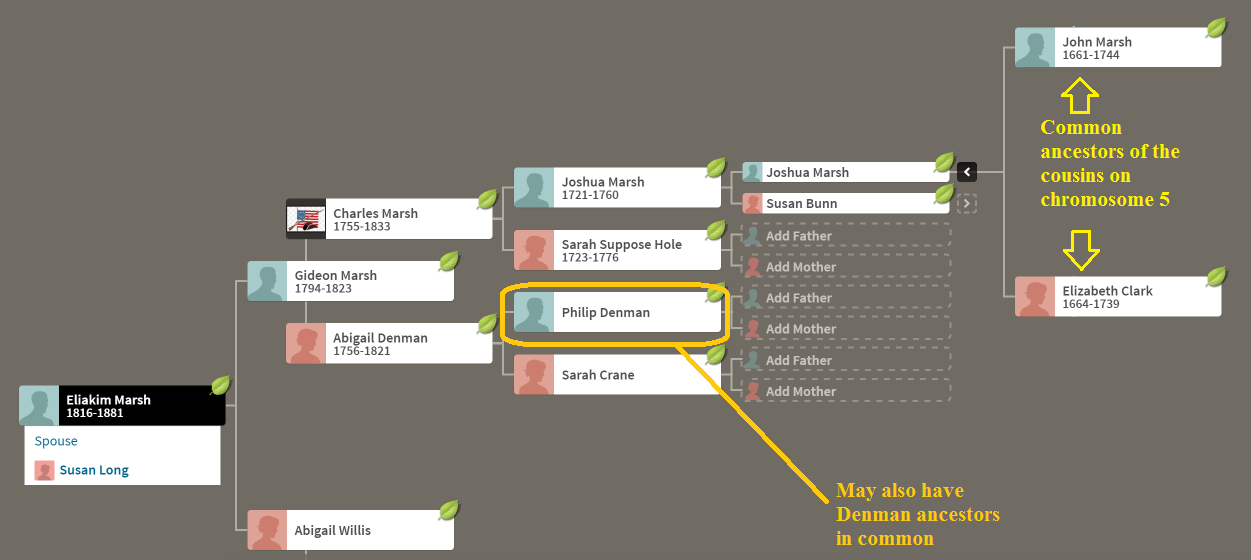
My father and Chris G's father share a segment of 25 cM on chromosome 5. Someone who tested at FamilyTreeDNA matched both men on this same spot with a slightly smaller segment of 15 cM.
We had to travel back in this distant DNA cousin's tree many generations until we were in New Jersey. The common ancestors are the 3rd great grandparents of Eliakim Marsh: John Marsh (1661-1744) and Elizabeth Clarke (1664-1739). They lived in Rahway and Elizabeth.
But- we may also have Denman ancestors in common. I have not confidently traced back beyond Eliakim Marsh's great grandfather, Philip Denman. This distant cousin also has Denman ancestors in Westfield, New Jersey.
Plus, Eliakim's mother, Abigail Willis, is another tail. She could share some ancestral lines with her husband.
We may end up with a situation seen with the Morris County DNA cousins, where we share multiple lines of ancestry and cannot isolate the DNA to a particular ancestor.
My question is: would this DNA cousin, who is probably a seventh or eighth cousin through these Marsh or Denman lines, share a segment of DNA 15 cM long? Shouldn't the segment have broken up into smaller, and perhaps not distinguishable, fragments? Is it possible that someone who was born in the 1660s still has a large segment of their DNA detectable in their descendants?
Thanks to everyone who participated in this effort through DNA testing and/or researching.
Chris G's father is a third cousin, once removed to my father and his siblings. As we approach the third cousin level, DNA may or may not be shared. We checked for shared DNA at GedMatch.com so that we could see all the shared segments.
One of my uncles shares only a tiny segment (3 cM) of DNA with Chris G's father. This would not have been reported as a match at the three major testing companies (23andMe, FamilyTreeDNA, and AncestryDNA), but GedMatch allows you to see tiny segments.
When we look at segments above 5 cM, the other siblings share larger segments with this third cousin:
My father shares two segments totaling 42.3 cM.
My aunt shares two segments totaling 46.9 cM.
My uncle shares one segment of 17.7 cM.
Next we looked at other people who also share these same segments. Anyone who matches my father and Chris G's father on the same segment will descend from Eliakim Marsh and Susan Long, or one of the ancestors of Eliakim or Susan.
My father and Chris G's father share a segment of 25 cM on chromosome 5. Someone who tested at FamilyTreeDNA matched both men on this same spot with a slightly smaller segment of 15 cM.
We had to travel back in this distant DNA cousin's tree many generations until we were in New Jersey. The common ancestors are the 3rd great grandparents of Eliakim Marsh: John Marsh (1661-1744) and Elizabeth Clarke (1664-1739). They lived in Rahway and Elizabeth.
But- we may also have Denman ancestors in common. I have not confidently traced back beyond Eliakim Marsh's great grandfather, Philip Denman. This distant cousin also has Denman ancestors in Westfield, New Jersey.
Plus, Eliakim's mother, Abigail Willis, is another tail. She could share some ancestral lines with her husband.
We may end up with a situation seen with the Morris County DNA cousins, where we share multiple lines of ancestry and cannot isolate the DNA to a particular ancestor.
My question is: would this DNA cousin, who is probably a seventh or eighth cousin through these Marsh or Denman lines, share a segment of DNA 15 cM long? Shouldn't the segment have broken up into smaller, and perhaps not distinguishable, fragments? Is it possible that someone who was born in the 1660s still has a large segment of their DNA detectable in their descendants?
Thanks to everyone who participated in this effort through DNA testing and/or researching.
Wednesday, July 27, 2016
Jonas Long and Elizabeth Merrell: A Union Documented in Death
With the collaboration of other researchers, we can answer the question I asked last year: Who were the parents of Susan Long (1818-1882)?
They were Jonas Long and Elizabeth Merrell. Estate records were the key in this mystery.
The Background
Susan Long of E Town [Elizabethtown] married Eliakim Marsh in Essex County, New Jersey in 1839. No parents were listed, which is not unusual for such records in this time period. Susan died in Elizabeth in 1882. [Elizabeth was in the newly created Union County by this time.] The death certificate listed her parents as Jonas Long and Elizabeth.
Online trees and webpages provided an unsourced marriage for Jonas Long and Elizabeth Merrell in 1816 in Piscataway, Middlesex County, New Jersey, and even provided birth and death dates for Jonas. Nobody who answered my inquiries could tell me where this information was found. This couple was also listed as parents of Richard Merrell, born around 1817 in New Jersey, who relocated to Virginia, married Elizabeth Culpepper, and died in 1861. Nobody could explain why Richard carried his mother's surname of Merrell.
So my tree looked like this:
Susan's only connection to Merrell was in the 1870 census in New Brunswick, Middlesex County, New Jersey. Phebe Merton, age 70, was living in Susan's household. Phebe was a daughter of Richard I Merrell (1774-1864) and Nancy Ann Cole (1776-1861).
The Impetus
Chris G, a descendant of Susan Long and Eliakim Marsh reached out to me. His DNA test at Ancestry.com matched him to a descendant of Richard Merrell (1817-1861) of Virginia, the supposed brother of our shared ancestor, Susan Long. [I will discuss the DNA in a separate article.] He asked if I had made any progress on locating records to better identify the origins of Susan Long.
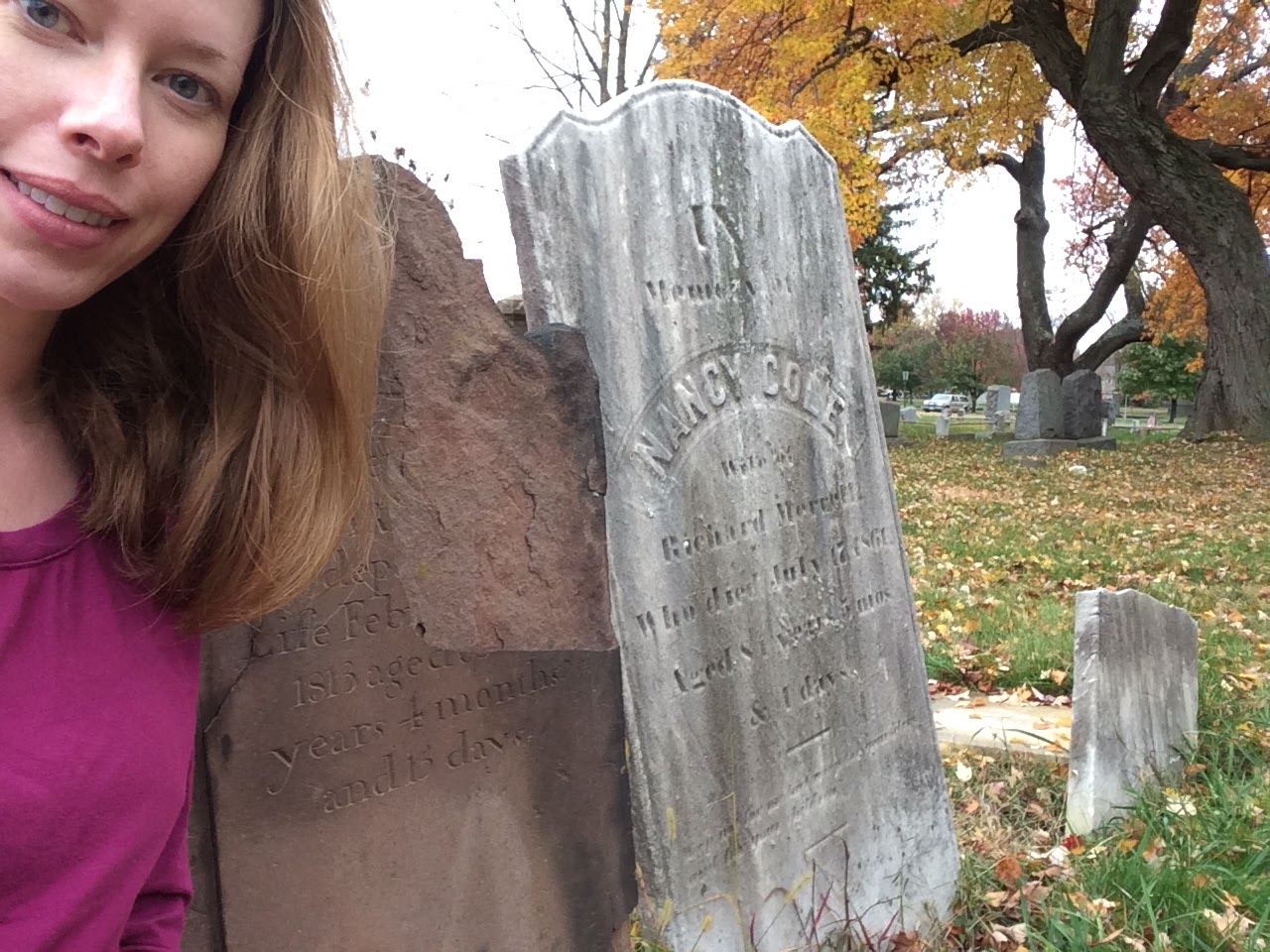
Well, no progress. But I did visit the Merrell grave on November 1, 2015 in Edison, though when they were buried it was Piscataway.
I could not find Elizabeth Merrell, wife of Jonas Long, in this cemetery. Among those buried here were Elizabeth's likely parents, Nancy Ann Cole (1776-1861) and Richard I Merrell (1774-1864).
The Strategy and Results
Richard I Merrell died after his wife and without a will in 1864. His estate was probated in Middlesex County, New Jersey. These papers are available (free) at FamilySearch.org. [Note that Ancestry.com provides an index, but not for every page associated with an estate. You need to go to FamilySearch.org and look at the court's docket and then locate the proceedings index, then locate all these files.]
At first I was disappointed because Elizabeth was not among the signatures of Richard's children. Phebe "Murton" was.
Some more digging through the estate papers produced a big piece of the puzzle. Elizabeth [Culpepper] Merrell of Norfolk County, Virginia, through her attorney-in-fact Abraham LONG of Elizabethport, New Jersey, petitioned for her three children to receive a part of Richard I Merrell's estate. She stated that their father was Richard Merrell, deceased; he was the son of Mrs Elizabeth Owens, deceased, and she was the daughter of Richard I Merrell whose estate was in probate.
The family tree now looked like this:
Elizabeth Merrell had remarried to a Mr Owens after Jonas Long died.
Chris G located Mrs Elizabeth Owens not in New Jersey, but in Northfield, Richmond County, New York- Staten Island.
The oysterman, Abram Long, living with Elizabeth looks like the attorney-in-fact for the Merrell family in Virginia. The 1850 census revealed Catherine Cook, another child of Elizabeth Merrell/Mrs Owens. Why were Elizabeth's children not in the estate papers of their grandfather?
I needed the distribution of the estate to see if the Long children inherited anything. This was not in the index, but I caught a mention of its location when carefully reading papers.
So Elizabeth Merrell and Mr Long were the parents of my Susan Long and she had six siblings!
Chris G again turned to Staten Island to provide some insight into Elizabeth Merrell's two husbands.
They were Jonas Long and Elizabeth Merrell. Estate records were the key in this mystery.
The Background
Susan Long of E Town [Elizabethtown] married Eliakim Marsh in Essex County, New Jersey in 1839. No parents were listed, which is not unusual for such records in this time period. Susan died in Elizabeth in 1882. [Elizabeth was in the newly created Union County by this time.] The death certificate listed her parents as Jonas Long and Elizabeth.
![]() |
| 1839 July 4 Eliakim Marsh of N Y city [New York City] to Susan Long of E Town [Elizabethtown, New Jersey] |
Online trees and webpages provided an unsourced marriage for Jonas Long and Elizabeth Merrell in 1816 in Piscataway, Middlesex County, New Jersey, and even provided birth and death dates for Jonas. Nobody who answered my inquiries could tell me where this information was found. This couple was also listed as parents of Richard Merrell, born around 1817 in New Jersey, who relocated to Virginia, married Elizabeth Culpepper, and died in 1861. Nobody could explain why Richard carried his mother's surname of Merrell.
So my tree looked like this:
Susan's only connection to Merrell was in the 1870 census in New Brunswick, Middlesex County, New Jersey. Phebe Merton, age 70, was living in Susan's household. Phebe was a daughter of Richard I Merrell (1774-1864) and Nancy Ann Cole (1776-1861).
The Impetus
Chris G, a descendant of Susan Long and Eliakim Marsh reached out to me. His DNA test at Ancestry.com matched him to a descendant of Richard Merrell (1817-1861) of Virginia, the supposed brother of our shared ancestor, Susan Long. [I will discuss the DNA in a separate article.] He asked if I had made any progress on locating records to better identify the origins of Susan Long.
Well, no progress. But I did visit the Merrell grave on November 1, 2015 in Edison, though when they were buried it was Piscataway.
I could not find Elizabeth Merrell, wife of Jonas Long, in this cemetery. Among those buried here were Elizabeth's likely parents, Nancy Ann Cole (1776-1861) and Richard I Merrell (1774-1864).
The Strategy and Results
Richard I Merrell died after his wife and without a will in 1864. His estate was probated in Middlesex County, New Jersey. These papers are available (free) at FamilySearch.org. [Note that Ancestry.com provides an index, but not for every page associated with an estate. You need to go to FamilySearch.org and look at the court's docket and then locate the proceedings index, then locate all these files.]
At first I was disappointed because Elizabeth was not among the signatures of Richard's children. Phebe "Murton" was.
Some more digging through the estate papers produced a big piece of the puzzle. Elizabeth [Culpepper] Merrell of Norfolk County, Virginia, through her attorney-in-fact Abraham LONG of Elizabethport, New Jersey, petitioned for her three children to receive a part of Richard I Merrell's estate. She stated that their father was Richard Merrell, deceased; he was the son of Mrs Elizabeth Owens, deceased, and she was the daughter of Richard I Merrell whose estate was in probate.
The family tree now looked like this:
Elizabeth Merrell had remarried to a Mr Owens after Jonas Long died.
Chris G located Mrs Elizabeth Owens not in New Jersey, but in Northfield, Richmond County, New York- Staten Island.
The oysterman, Abram Long, living with Elizabeth looks like the attorney-in-fact for the Merrell family in Virginia. The 1850 census revealed Catherine Cook, another child of Elizabeth Merrell/Mrs Owens. Why were Elizabeth's children not in the estate papers of their grandfather?
I needed the distribution of the estate to see if the Long children inherited anything. This was not in the index, but I caught a mention of its location when carefully reading papers.
In the Releases and Discharges, "six of the children of Elizabeth Long a deceased daughter of Richard I Merrill late deceased" were listed:
Abram M Long
John M Long
Jacob V P Long
Susanna Marsh, wife of Eliakim Marsh
Catharine A Cook, widow
Letitia F Birch, wife of Edward Birch
Elizabeth Merrell's first son, Richard Merrell, who died in 1861 in Virginia, was not listed. This omission could be why Richard's widow placed a claim in 1866 for her three children.
Chris G again turned to Staten Island to provide some insight into Elizabeth Merrell's two husbands.
In 1860, Elizabeth filed in Richmond County, New York to administer the estates of her two husbands:
Jonas Long, who died August 13, 1837; and
William Owens, who died October 1, 1853.
Seven children are listed for both men. Richard is listed as the first child of Jonas Long.
I don't know why Elizabeth waited to probate these estates. She died sometime between the 1860 census and her father's death in 1864.
Future Research
Who were the parents of Jonas Long (died 1837)? The discovery of five more of his children provide opportunities to uncover interactions with the Long side of the family. If Jonas' son Jacob V P Long was named for Jacob Van Pelt, this could be a generation back on the Long line.
Where are Jonas Long and Elizabeth Merrell buried? When did Elizabeth die? Elizabeth's (second) husband, William Owens, is supposedly buried at the Merrell Cemetery in Bulls Head, Staten Island. FindAGrave provides a date of death in 1852 with no picture of a headstone, while the estate index has 1853.
Why did Richard Merrell who died in Virginia in 1861 use his mother's surname and not his father's? Why did he move to Virginia? Were his children initially omitted from their great grandfather's estate? Was contact lost because of the Civil War, or does their possible omission indicate that Richard Merrell was not a full sibling to the six Long children?
Thank you to the other researchers who helped bring this fractured branch together.
Tuesday, July 19, 2016
A More Detailed Divorce
Two years ago I shared the discoveries found in the divorce records of my great grandparents, Howard Lutter (1889-1959) and Ethel Laurel Winterton (1891-1962). Howard filed for divorce on October 27, 1926 in New Jersey on the grounds that Ethel had abandoned him and their two children. Ethel did not respond.
Howard remarried to Fiorita Lorenz in on October 28, 1928 in New York City. Fiorita herself was newly divorced from James Winnie. Howard boarded at the home of Fiorita and James in the 1920s. Fiorita testified on Howard's behalf in his divorce case, omitting that her current address was not with her husband but rather with Howard's mother.
I wondered what really happened to end these two marriages. Fiorita's divorce papers provided the expected details.
Fiorita filed for divorce in 1927 alleging that her husband, James Winnie, committed adultery with Mildred L Yunker in Newark.
James Winnie responded that Fiorita committed adultery with Howard Luther.
October 9, 1926 is the day of the break up claimed by Fiorita and James. Howard Lutter filed for his divorce two weeks later.
In the 1930 census, James was living in Irvington with Laura M Winnie and stepson Clifford C Yunker. I did not find a marriage record for them in New Jersey from 1928-1930. [Note: Brocker was Mildred/Laura's former name.]
In 1930, Howard Lutter was living with Fiorita in Bloomfield with his two children, Clifford and Beryl, and one of hers, Rita.
You can read the divorce records for both couples at Dropbox.
Howard remarried to Fiorita Lorenz in on October 28, 1928 in New York City. Fiorita herself was newly divorced from James Winnie. Howard boarded at the home of Fiorita and James in the 1920s. Fiorita testified on Howard's behalf in his divorce case, omitting that her current address was not with her husband but rather with Howard's mother.
I wondered what really happened to end these two marriages. Fiorita's divorce papers provided the expected details.
Fiorita filed for divorce in 1927 alleging that her husband, James Winnie, committed adultery with Mildred L Yunker in Newark.
James Winnie responded that Fiorita committed adultery with Howard Luther.
October 9, 1926 is the day of the break up claimed by Fiorita and James. Howard Lutter filed for his divorce two weeks later.
In the 1930 census, James was living in Irvington with Laura M Winnie and stepson Clifford C Yunker. I did not find a marriage record for them in New Jersey from 1928-1930. [Note: Brocker was Mildred/Laura's former name.]
In 1930, Howard Lutter was living with Fiorita in Bloomfield with his two children, Clifford and Beryl, and one of hers, Rita.
You can read the divorce records for both couples at Dropbox.
Tuesday, June 28, 2016
New York City Marriage Records: Application, Affidavit, and License for a Second Marriage
When the New York City Marriage Index was published online (thanks to Reclaim the Records), I requested copies of the Application, Affidavit, and License for two couples. Records from 1928 for the first couple, Robert Paul Shaw and Jane Louise Sonntag, arrived a few weeks ago. The genealogical gem contained in these records, and not contained on the marriage return, was that the whereabouts of the bride's father were unknown.
Records for my great grandfather's second marriage in 1928 just arrived, three weeks later than the first request, perhaps because more documents were included.
Howard Lutter and Fiorita Lorenz married in New York City on October 10, 1928. This was a second marriage for both of them after divorcing their first spouses. The packet from the New York City Municipal Archives included copies of the divorce decrees of both parties.
Howard Lutter divorced Laura (Ethel) Winterton in 1927. The testimony of Fiorita Lorenz and other witnesses painted Laura as disinterested in her husband, children, and housekeeping duties.
Fiorita Lorenz was still married to James Howard Winnie when Howard Lutter and children moved into the Winnie home in Bloomfield, New Jersey. In 1928, Fiorita divorced James for adultery. The divorced was finalized September 6, 1928 in Essex County, New Jersey. Fiorita sailed to France and returned to New York on October 9, 1928. The next day she married Howard Lutter.
I still need to track down copies of the divorce testimony for Fiorita Lorenz and James Howard Winnie. The divorce records for Howard Lutter and Laura Winterton can be found on DropBox along with the additional New York City marriage records.
Howard Lutter and Fiorita Lorenz married in New York City on October 10, 1928. This was a second marriage for both of them after divorcing their first spouses. The packet from the New York City Municipal Archives included copies of the divorce decrees of both parties.
Howard Lutter divorced Laura (Ethel) Winterton in 1927. The testimony of Fiorita Lorenz and other witnesses painted Laura as disinterested in her husband, children, and housekeeping duties.
Fiorita Lorenz was still married to James Howard Winnie when Howard Lutter and children moved into the Winnie home in Bloomfield, New Jersey. In 1928, Fiorita divorced James for adultery. The divorced was finalized September 6, 1928 in Essex County, New Jersey. Fiorita sailed to France and returned to New York on October 9, 1928. The next day she married Howard Lutter.
I still need to track down copies of the divorce testimony for Fiorita Lorenz and James Howard Winnie. The divorce records for Howard Lutter and Laura Winterton can be found on DropBox along with the additional New York City marriage records.
Monday, June 27, 2016
An Exact Match for ODonnell Y-DNA
My ODonnell cousin has an exact match for his Y-DNA test at the 37 marker level at FamilyTreeDNA.
This surname of this Y-DNA cousin is not ODonnell or a variant. FamilyTreeDNA provides a "Tip" report, estimating the chances that these two individuals share a common paternal line ancestor as we go back through the generations. By the time we go back seven generations, there is a 95% chance that the lines will have merged.
This match can trace his direct paternal line back about two hundred years to the Isle of Bute in Scotland. I can also trace back two hundred years, but land in Donegal, Ireland. These two locations were near enough to be accessible around the year 1800.
If someone is knowledgeable about traveling in Ireland and Scotland in this time period, please weigh in.
Francis Patrick ODonnell was born about 1856 in Killybegs and came to New Jersey, United States, before 1880. So the lines were separated by an ocean for three generations. If they arise from the same ancestor, this merging will be found in the early 1800s or 1700s.
If this 37 marker Y-DNA match is related within seven generations, he may share autosomal DNA with any of my ODonnell relatives. He has not done this type of DNA test, though.
My ODonnell cousin has thousands of matches in his Y-DNA results. Even an exact match may not be a match at all because of convergence. Markers change over time. These two people may not be recently related, but rather their marker values could have mutated towards the same values and are now identical.
So far, there is only one ODonnell match at the 111 marker level. This is the same person who was the initial top match at the 37 marker level. Both testers upgraded to 111 markers and still match very closely, 106 out of 111 markers. Two hundred years ago his ODonnell ancestors were in Boston, Massachusettes.
Without other ODonnell cousins with similar Y-DNA markers, we cannot be secure in our placement as an ODonnell line based on markers alone. In an upcoming article, I will demonstrate the necessity of using the markers of multiple distant cousins with my Duryea line.
This surname of this Y-DNA cousin is not ODonnell or a variant. FamilyTreeDNA provides a "Tip" report, estimating the chances that these two individuals share a common paternal line ancestor as we go back through the generations. By the time we go back seven generations, there is a 95% chance that the lines will have merged.
This match can trace his direct paternal line back about two hundred years to the Isle of Bute in Scotland. I can also trace back two hundred years, but land in Donegal, Ireland. These two locations were near enough to be accessible around the year 1800.
If someone is knowledgeable about traveling in Ireland and Scotland in this time period, please weigh in.
Francis Patrick ODonnell was born about 1856 in Killybegs and came to New Jersey, United States, before 1880. So the lines were separated by an ocean for three generations. If they arise from the same ancestor, this merging will be found in the early 1800s or 1700s.
If this 37 marker Y-DNA match is related within seven generations, he may share autosomal DNA with any of my ODonnell relatives. He has not done this type of DNA test, though.
My ODonnell cousin has thousands of matches in his Y-DNA results. Even an exact match may not be a match at all because of convergence. Markers change over time. These two people may not be recently related, but rather their marker values could have mutated towards the same values and are now identical.
So far, there is only one ODonnell match at the 111 marker level. This is the same person who was the initial top match at the 37 marker level. Both testers upgraded to 111 markers and still match very closely, 106 out of 111 markers. Two hundred years ago his ODonnell ancestors were in Boston, Massachusettes.
Without other ODonnell cousins with similar Y-DNA markers, we cannot be secure in our placement as an ODonnell line based on markers alone. In an upcoming article, I will demonstrate the necessity of using the markers of multiple distant cousins with my Duryea line.
Sunday, June 26, 2016
Photographs in a Series Reunited
A cousin kindly sent me some more family photographs. (Thank you D.W.!)
A snow scene caught my eye. My aunt had given me a similar picture a few years ago of a couple standing in snow, the woman holding a snowball.
These people are still unidentified. Based on who inherited these pictures, they come from the Walling and Winterton branches of the family tree. They lived in the Keyport area of Monmouth County, New Jersey.
In an earlier article, I compared an identified photograph from a cousin to unidentified photographs I received years ago and determined that they are from the Walling and Winterton branches.
The pictures and heirlooms handed down through the generations are analogous to DNA. Each child receives different bits of the parent's DNA and passes the different parts down to their descendants.
My branch received some tools from David Uhl (1834-1884), while a cousin received other tools, all marked with UHL to signify the common origin.
A snow scene caught my eye. My aunt had given me a similar picture a few years ago of a couple standing in snow, the woman holding a snowball.
These people are still unidentified. Based on who inherited these pictures, they come from the Walling and Winterton branches of the family tree. They lived in the Keyport area of Monmouth County, New Jersey.
In an earlier article, I compared an identified photograph from a cousin to unidentified photographs I received years ago and determined that they are from the Walling and Winterton branches.
The pictures and heirlooms handed down through the generations are analogous to DNA. Each child receives different bits of the parent's DNA and passes the different parts down to their descendants.
My branch received some tools from David Uhl (1834-1884), while a cousin received other tools, all marked with UHL to signify the common origin.
Saturday, June 18, 2016
German Y-DNA Match
My father finally has a Y-DNA match at Family Tree DNA.
Both my father and the person who is a match tested 37 markers. His surname is not Lutter.
(Another person tested 111 markers, but there are too many differences to qualify as a reportable match beyond 12 markers.)
FamilyTreeDNA did not report this new person as a match at the 37 marker level. When I compared the actual numbers, they have five differences out of 37. The values are off by only one for each difference. Without testing additional cousins from these lines, we have nobody else to compare to determine if this man and my father might share a common direct paternal ancestor.
This other person has roots in Germany. He can trace his direct paternal line to about 1830, which is how many years back I can get on my Lutter line. His line originated in Treppeln, Brandenburg. Mine was from Scheibe, Thueringen. Treppeln is a few miles west of the current border with Poland and is about 180 miles northeast of Scheibe. If I have the correct Treppeln.
Both my father and the person who is a match tested 37 markers. His surname is not Lutter.
(Another person tested 111 markers, but there are too many differences to qualify as a reportable match beyond 12 markers.)
FamilyTreeDNA did not report this new person as a match at the 37 marker level. When I compared the actual numbers, they have five differences out of 37. The values are off by only one for each difference. Without testing additional cousins from these lines, we have nobody else to compare to determine if this man and my father might share a common direct paternal ancestor.
This other person has roots in Germany. He can trace his direct paternal line to about 1830, which is how many years back I can get on my Lutter line. His line originated in Treppeln, Brandenburg. Mine was from Scheibe, Thueringen. Treppeln is a few miles west of the current border with Poland and is about 180 miles northeast of Scheibe. If I have the correct Treppeln.
Subscribe to:
Posts (Atom)